
Close your eyes for a second and picture a dusty school classroom. The teacher is tapping a chalkboard with a wooden stick, drawing a triangle with a sharp square corner.
“Repeat after me,” the teacher says. “A squared plus B squared equals C squared. It’s called the Pythagorean Theorem.”
Generations of students worldwide have memorized this exact rule, conditioned to believe it was handed down to us by a Greek philosopher named Pythagoras who lived around 500 BCE. But what if we told you that centuries before Pythagoras even picked up a stylus to write his name, an ancient Indian sage was already using simple ropes, wooden pegs, and brilliant geometry to map out the exact same secret of the right-angled triangle?
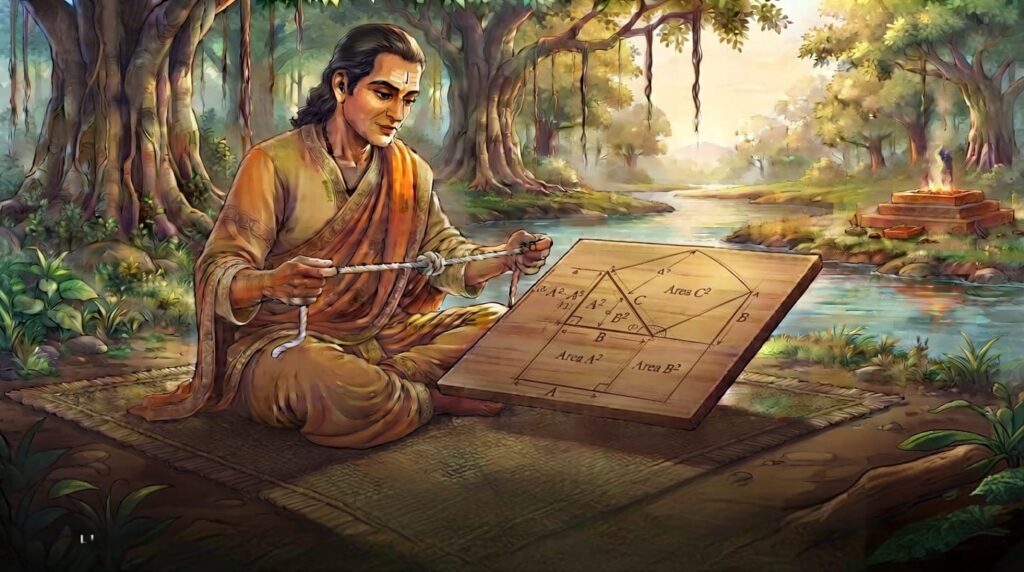
Welcome to the world of Baudhayana, a master architect and mathematician whose genius was carved into sacred Sanskrit texts long before Greece was even a regional superpower. Understanding this isn’t just about trivia or national pride—it is about reclaiming a lost chapter of human history, correcting historical blind spots, and recognizing how ancient wisdom directly shapes the architecture, engineering, and digital maps we use today.
Meet Baudhayana: The Man Behind the Sacred Ropes
Long before pocket calculators, digital graphing apps, or even standard steel rulers existed, people needed foolproof ways to measure land, build houses, and construct massive community fire altars (vedis) for sacred rituals. If an altar was built even slightly crooked or the wrong size, people believed the ceremony wouldn’t work. Precision was absolute law.
Enter Baudhayana (living around 800 BCE), a brilliant Vedic priest, astronomer, and mathematician. He didn’t sit in a modern air-conditioned office with a laptop; instead, he encoded complex geometric rules into rhythmic Sanskrit poetry. His masterwork was the Baudhayana Sulba Sutra—part of a collection of manuals on how to measure (Sulba literally means “cord” or “rope”).
“The Sulba Sutras are like a guide to the Vedas which formulate rules for constructing altars. In other words, they provide techniques to solve mathematical problems effortlessly.” — Historical Mathematical Archive
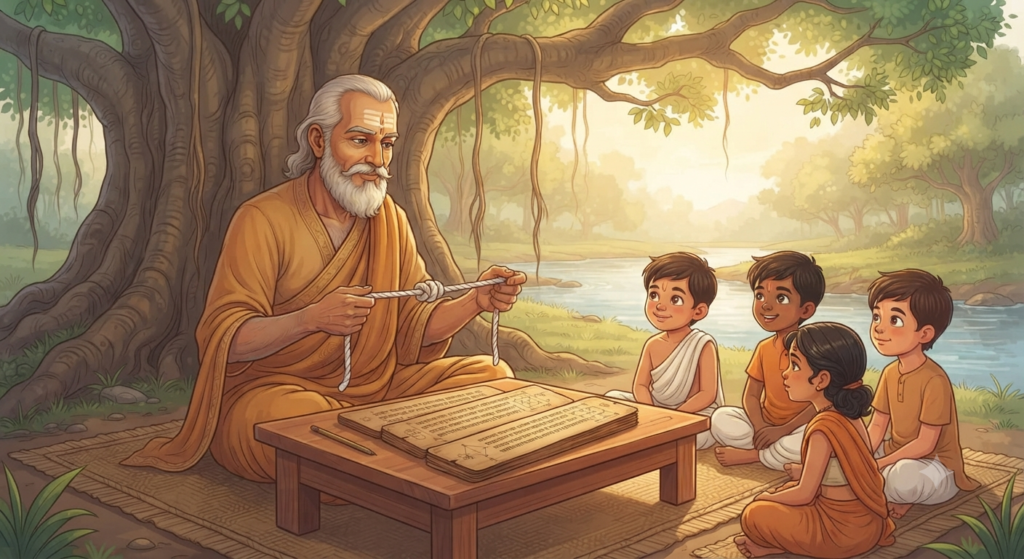
Instead of abstract numbers on a whiteboard, Baudhayana used everyday tools: colored threads, wooden stakes, and stretched ropes. He turned geometry into a practical playground where anyone could master proportions.
The Secret Code of the Stretched Rope
How did Baudhayana discover the relationship of a right-angled triangle without modern algebra? By playing with ropes!
In his text, he wrote a famous verse (shloka) that translates directly to the modern geometric rule we use today:
दीर्घचतुरस्रस्याक्ष्णया रज्जुः पार्श्वमानी तिर्यग् मानी च यत् पृथग् भूते कुरूतस्तदुभयं करोति ॥
Dīrghachaturasryākṣaṇayā rajjuḥ pārśvamānī, tiryagmānī, cha yatpṛthagbhūte kurutastadubhayāṅ karoti.
What does this mean in plain English? Baudhayana stated: “The diagonal of a rectangle produces by itself both the areas which the two sides of the rectangle produce separately.”
Imagine taking a piece of rope, laying it along the slanting side (the diagonal) of a rectangle, and making a square out of it. Baudhayana realized that the exact area of this giant square is equal to the combined areas of the squares made by the shorter side and the longer side.
When you narrow that rectangle down to a right-angled triangle, you get a2 + b2 = c2 Baudhayana was playing geometry chess centuries before Pythagoras was even born.
Magic Numbers: The Baudhayana Triples
Baudhayana didn’t just stop at describing the rule; he gave builders handy shortcuts called “triplets”—sets of whole numbers that fit the right-triangle rule perfectly without leaving awkward fractions.
If you take a rope of length 3 units, another of 4 units, and a third of 5 units, they will magically form a crisp, flawless 90-degree corner. Baudhayana listed multiple sets like (3, 4, 5), (5, 12, 13), and (8, 15, 17) in his Sulba Sutra. Ancient builders used these numbers as secret construction blueprints to ensure that their brick altars and buildings stood strong, straight, and symmetrical.

As noted in modern educational frameworks like India’s NCERT Class 8 mathematics textbook, recognizing these contributions brings light to a rich legacy:
“Ancient Indian mathematician Baudhayana was the first person to formulate a theorem on right-angled triangles that in its modern form came to be associated with Greek mathematician Pythagoras…”
Why Did History Forget?
If Baudhayana figured this out around 800 BCE, why do we call it the Pythagorean Theorem today?
History is often written by those who travel, trade, and widely publish texts in formats that later Western historians translated first. Pythagoras (born around 570–495 BCE) travelled extensively, studied in various ancient hubs of learning, and his school heavily popularized the mathematical proof of the concept across the Mediterranean. Centuries later, Roman writers like Cicero credited Pythagoras, and the name stuck globally.
However, historical timelines don’t lie: Baudhayana’s texts predate Pythagoras by at least 200 to 300 years. The Sulba Sutras stand preserved as independent, written proof that the foundational rules of geometry were blossoming brilliantly along the banks of ancient Indian rivers.
Why Is Correct History So Important?
You might wonder: Does it really matter who figured it out first, as long as we have the formula today?
The answer is a resounding yes. History is not just a list of dates and dead names; it shapes how a civilization views its own intellectual capabilities. For centuries, colonial and Eurocentric historiography portrayed science and mathematics as an exclusively Western invention, where ideas flowed from Greece to Europe, while non-Western cultures were viewed merely as spiritual or artistic.
By acknowledging Baudhayana, we correct a profound historical imbalance. We show children—especially in Bharat—that their ancestors were rigorous scientists, engineers, and problem-solvers who relied on empirical observation, logic, and practical experimentation. When kids learn that the foundation of modern engineering was built by Indian sages using ropes and stakes, it builds a deep, unshakeable sense of intellectual confidence. It teaches them that innovation is part of their cultural DNA.
From Ancient Altars to Modern Tech: Why It Matters Today
Ancient geometry wasn’t just about building fire altars; it laid the groundwork for everything we see around us today.
- Architecture and Civil Engineering: Every time an architect designs a skyscraper, a bridge, or a residential home, they rely on right-angled triangles to ensure structural stability. Without accurate corner measurements, buildings would collapse.
- Computer Graphics and Video Games: Think of your favorite 3D video game or animated movie. The computer renders complex worlds by breaking characters and landscapes down into millions of tiny triangles. The distance between points in a 3D digital space is calculated using an extension of a2 + b2 = c2 (known as the Euclidean distance formula).
- GPS and Navigation: Your smartphone’s GPS app uses triangulation to figure out your exact location on Earth by measuring distances from satellites. The fundamental math traces its lineage straight back to the geometric principles mapped out in ancient texts.

Fun Facts to Impress Your Friends
- Not Just Triangles: Baudhayana also figured out how to turn a square into a circle of nearly equal area—an early step toward calculating the value of π(Pi)!
- The Root of Mystery: His texts feature one of the earliest known approximations of the square root of 2√2, accurate to several decimal places, used for scaling altar sizes up and down.
- Rope-Stretchers: In ancient India, geometry experts were literally called Sulba-vidas—the “Knowers of the Cord.”
Next time you draw a triangle in math class and write down a2 + b2 = c2, tip your hat to the ancient sage of Bharat who mapped out the universe with a simple piece of string.
ज्ञानेन तु तदज्ञानं जेशां प्रनष्टमात्मनः। तेषामादित्यवज्ज्ञानं प्रकाशयति तत्परम्॥ – Bhagavad Gita, Chapter 5, Verse 16
When ignorance is destroyed by self-knowledge, that knowledge shines like the sun and reveals the ultimate truth.
References & Sources
- The Baudhāyana Śulbasūtra – Translated by George Thibaut, published in The Pandit (1875–1877).
- NCERT Class 8 Mathematics Textbook (Ganita Prakash) – National Council of Educational Research and Training, highlighting ancient Indian geometric contributions.
- The Crest of the Peacock: Non-European Roots of Mathematics – George Gheverghese Joseph (Penguin Books, 2000).
- A History of Mathematics: An Introduction – Vincent J. Katz (Addison-Wesley, 1998).
- Indian Mathematics and Astronomy: Some Landmarks – S. Balachandra Rao (Jnana Deep Publications, 1998).