
Stand on the sun-bleached shores of Goa or the historic coast of Gokarna today, watch the waves crash against the rocky outcrops, and you are looking at an ancient liquid highway. For most of us, history lessons are written in the dust of battlefields, the towering stones of capital cities, and the dry chronologies of land-conquering kings. We picture empires marching across dusty northern plains on horse and elephant.
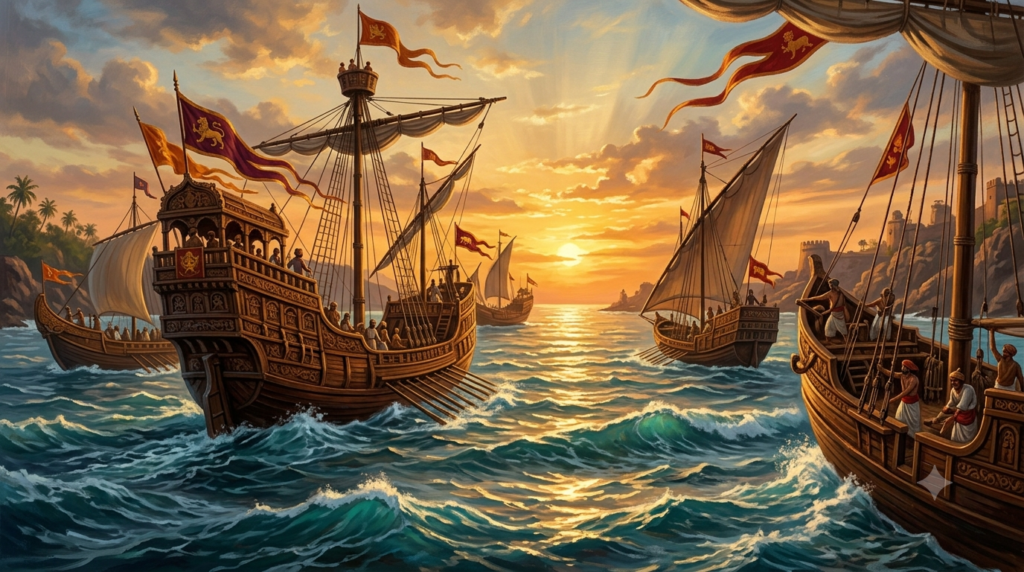
Yet, there is an entire half of India’s story that smells of salt spray, teakwood shipyards, and exotic spices—a story written not on parchment, but across the blue expanse of the Arabian Sea and the Indian Ocean. Long before European colonial frigates ever dropped anchor on our shores, the great imperial powers of the western coast—specifically the Kadambas of Banavasi and the Chalukyas of Badami—wielded absolute maritime supremacy.
The Rise of the Forest Lords—The Kadambas of Banavasi
To understand how Indian kingdoms mastered the seas, we must first trace the origins of the Kadambas, one of the earliest indigenous dynasties of the Deccan. Long before they commanded fleets of galleys, their story began in the deep, emerald-green evergreen forests of Banavasi, in present-day Karnataka.
According to ancient inscriptions and epigraphic records, the dynasty was founded in the 4th century CE by Mayurasharma, a brilliant scholar and martial artist who bristled against the hegemony of the Pallavas. Legend and history intertwine to tell the tale of a young Brahmin student who travelled to Kanchi for higher education, only to be humiliated by royal guards. Enraged, Mayurasharma cast aside his sacred texts, took up the sword, established a formidable militia in the forests, and forced the Pallava rulers to formally recognize his sovereign state.

From these rugged, inland forest beginnings, the Kadambas expanded westward toward the Arabian Sea. They realised an essential geopolitical truth: to be an invincible empire, you cannot hold the soil alone; you must master the shore.
As they pushed toward the Konkan coast, they absorbed, protected, and transformed ancient port settlements. Under rulers like Kakusthavarma, the Kadamba realm became a cosmopolitan powerhouse. Their capital at Banavasi was celebrated in classical literature as a city rivalling the heavens, while their coastal outposts—such as Gopakapattana (modern Goa) and Chandor—transformed into bustling international hubs where gold coins from Rome and the Byzantine Empire flowed like water. The Kadambas minted fine gold coins stamped with their royal insignia, the fierce Padmanka (lotus) and the roaring lion, symbols that became trusted currencies across Arabian Sea trade routes.
The Chalukya Colossus—Masters of Land and Sea
While the Kadambas laid deep roots along the western seaboard, the Chalukyas of Badami (Vatapi) rose to become the undisputed imperial overlords of the Deccan from the 6th to the 8th century. Under visionary monarchs like Pulakeshin II and Vikramaditya I, the Chalukyan empire stretched from sea to sea, bridging the western and eastern coasts of peninsular India.
Mainstream history often remembers Pulakeshin II for his legendary defense of the Narmada River, where he famously halted the northern emperor Harshavardhana in his tracks. But Pulakeshin’s strategic brilliance extended far beyond land battles; he understood that the wealth of an empire lived in its harbors.
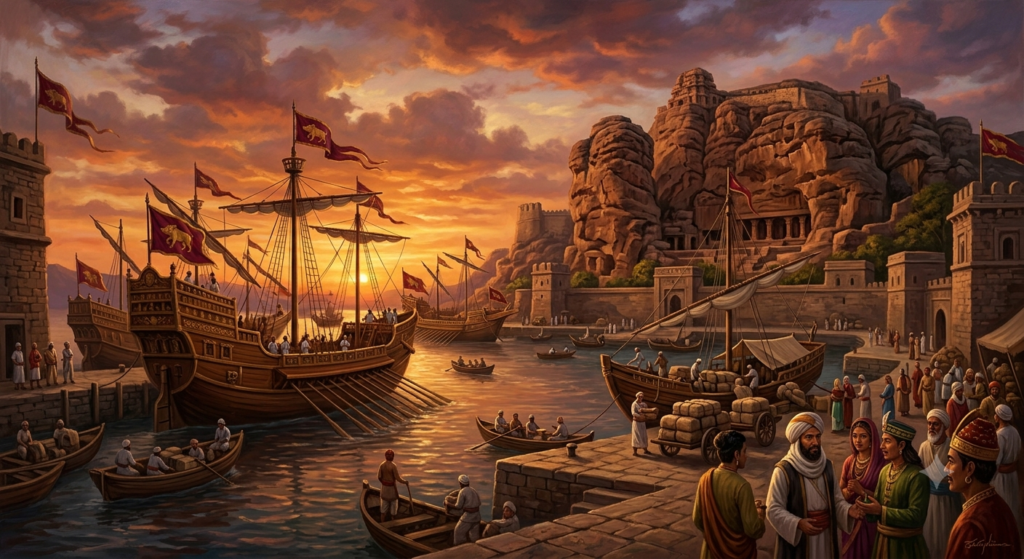
Historical accounts and copper-plate inscriptions describe the Chalukyan military machine as a dual-force marvel. They maintained not only a relentless cavalry and elephant corps for the Deccan plateau, but a formidable naval armada.
- The Siege of Puri: In a massive display of naval power, Pulakeshin II dispatched a fleet of war-ships across the Arabian Sea to subdue Puri (an ancient island stronghold off the Konkan coast, distinct from the Odisha pilgrimage site), breaking the power of the local Maurya rulers of the Konkan.
- Global Diplomacy: Chalukya court records and foreign chronicles indicate diplomatic and commercial exchanges extending all the way to the Sasanian Court of Persia. Persian murals in palaces abroad are even believed to depict Indian embassies sent by Chalukya emperors, showcasing a state deeply plugged into international geopolitics.
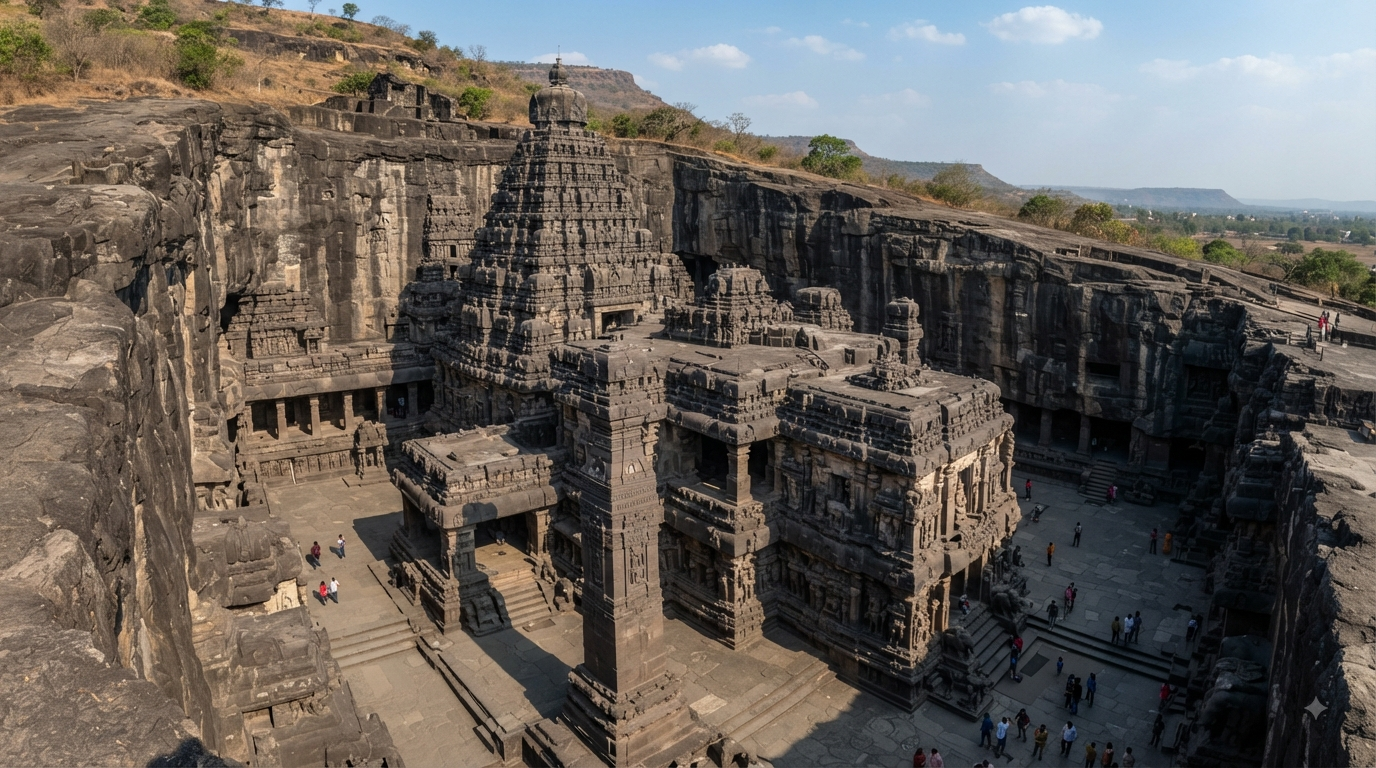
Under the Chalukyas, art, rock-cut architecture (such as the breathtaking cave temples at Badami and Aihole), and maritime commerce formed an unshakeable triad. They taxed incoming merchant vessels, regulated guilds, and provided state protection to foreign and domestic traders alike.
The Myth of the Landlocked Subcontinent
For generations, standard historical narratives have conditioned us to believe that India’s geopolitical story is confined strictly to land battles—the dust of the Gangetic plains, imperial cavalry charges across the Deccan, or mountain passes in the north. Yet, eminent epigraphist and historian Dr. P. Gururaja Bhatt noted:
“The maritime activity of the western coast was not a mere byproduct of casual local trade; it was a carefully curated, state-backed geopolitical strategy that placed Indian monarchs at the center of global commerce.”
When the Kadamba dynasty established its magnificent capital at Gopakapattana (modern-day Goa Velha) under ambitious rulers like Jayakeshi I, they were not just building a coastal town—they were engineering a sprawling maritime metropolis. Gopakapattana sat strategically on the Zuari estuary, acting as a gateway looking out toward the open, trade-rich Arabian Sea.
The Engineering of Ancient Navigation
How did these empires dominate a treacherous ocean without modern satellite navigation, steel hulls, or motorized engines? The answer lies in indigenous genius, advanced materials science, and deep ecological observation.
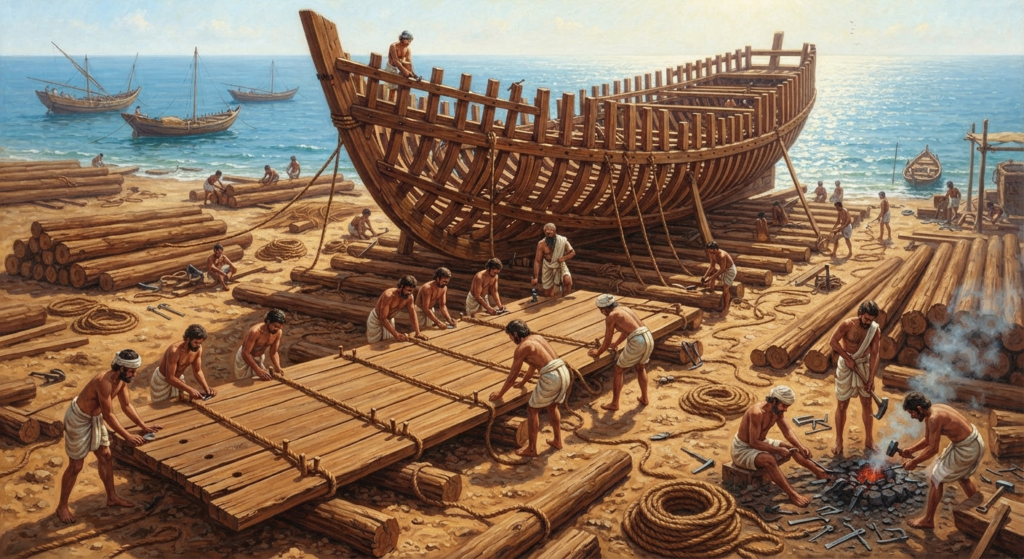
- The Art of Stitch-Built and Teak Ships: Indian shipwrights mastered the construction of ocean-going vessels using local resilient timbers like teak. Crucially, many indigenous ships utilized advanced stitching techniques (using coir rope to bind hull planks) combined with iron fasteners, making hulls flexible enough to absorb the brutal pounding of monsoon waves without shattering—a technique marvelled at by foreign travellers.
- Monsoon Literacy: Ancient Indian mariners didn’t fight the monsoons; they harnessed them. By mastering the predictable rhythm of the seasonal wind reversals, Kadamba and Chalukya merchant fleets timed their voyages precisely, sailing westward to the Middle East and East Africa with the summer southwest monsoon, and returning home with the winter northeast breeze.
- Lighthouses and Coastal Beacons: To guide midnight traders safely into rocky harbours, coastal administrators established early optical warning systems, hilltop fire-beacons, and charted submerged reefs, creating an organized, state-regulated marine infrastructure.
- The Strategic Port Network: Ports from Honnavar and Mangalore to Gopakapattana featured advanced customs houses, lighthouses, and dedicated residential quarters for international merchant guilds from Arabia, Persia, Rome, and Southeast Asia.
- The Sovereign Navy: The Kadambas and Chalukyas maintained standing naval fleets that aggressively cleared piracy out of the Arabian Sea, guaranteeing absolute safety for commercial vessels. Historical copperplates proudly title Kadamba monarchs as “Gopakākhya-puravara-adheeshwara”—Lord of the illustrious city of Goa, master of the western waters.
When regional rivals or internal factions attempted to disrupt trade, royal naval blockades were deployed with surgical precision, proving that statecraft on water was just as sophisticated as governance on land.
Did you know? Archaeological excavations around ancient Goan ports have unearthed Roman amphorae, Chinese celadon pottery, and Persian coins, proving that ancient India was the bustling financial hub of the medieval global economy.
Why This History Belongs to Today’s Generation
In an era where we look to global logistics, international trade, and digital supply chains, it is easy to feel that globalization is a purely modern phenomenon. We are often conditioned to think our ancestors were inward-looking villagers. Uncovering the maritime prowess of the Kadambas and Chalukyas shatters this illusion:
- The Original Global Connectors: When Roman writers like Pliny the Elder complained that Rome was bleeding its treasury dry buying luxury silks, spices, and muslins from Indian ports, it was Indian merchant fleets and coastal kingdoms driving that global market.
- Redefining the “Blue Economy”: Today, India talks extensively about the “Blue Economy” and Indo-Pacific security. Knowing that our ancestors successfully managed international maritime security and oceanic commerce a thousand years ago gives today’s young engineers, entrepreneurs, and strategists a profound historical anchor. It proves that maritime vision is written in our very DNA.
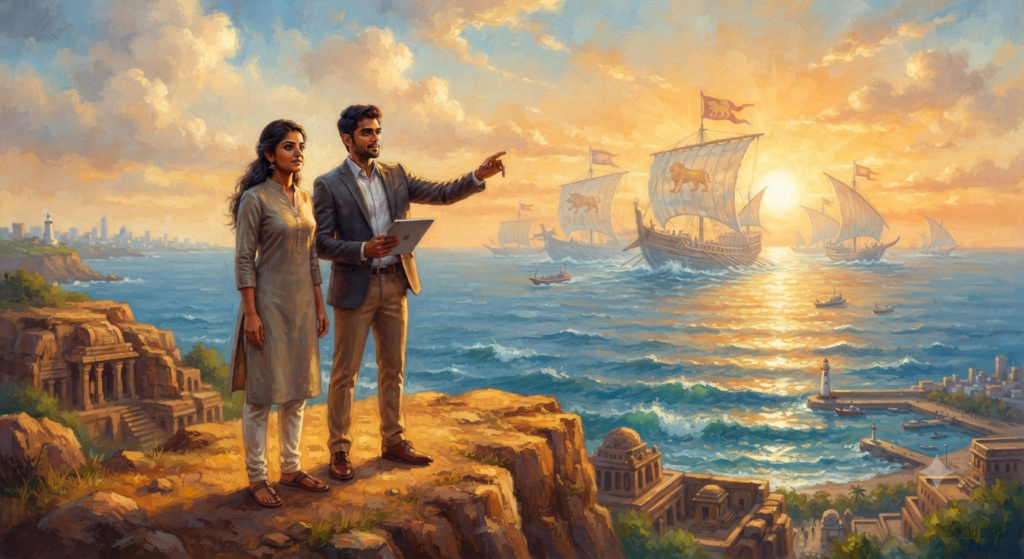
In an era driven by global logistics, tech startups, international supply chains, and modern “Blue Economy” strategies, young Indians today need to recognize a profound reality: Globalism is not a Western invention; it is our ancestral legacy.
Knowing this history shatters the lingering inferiority complex suggesting that our technological or global outlook began only with colonization. Centuries ago, Indian ports were the Silicon Valleys of international trade. Ships built in Indian dockyards carried spices, fine textiles, advanced metallurgy, and profound philosophies across the globe.
As renowned archaeologist Dr. S.R. Rao observed regarding India’s ancient seafaring traditions:
“The maritime horizon of ancient India was boundless; her merchants and mariners mapped the monsoons and bridged continents through mutual respect, commerce, and culture.”
As we walk along Goa’s sandy beaches or explore the ancient stone temples of Badami, let us listen closer. Beneath the sound of the modern tourist crowds lies the faint, enduring echo of timber shipyards, bustling currency markets, and majestic royal standards fluttering over seafaring galleys. The Kadamba and Chalukya kings carved their ambitions not just into cave walls, but into the infinite blue of the Indian Ocean.
Reclaiming Our Civilizational Pride
Whether you are a Gen Z coder designing the future, a millennial entrepreneur scaling global markets, or a proud boomer cherishing our civilizational roots, this history belongs to all of us. It reminds every generation that our ancestors were fearless innovators who looked at the vast, intimidating ocean not as an insurmountable barrier, but as a highway connecting Bharat to the world.
When we look at India’s modern maritime ambitions today—from cutting-edge naval defense doctrines to indigenous aircraft carriers—we are not starting from scratch. We are simply awakening an ancient, proud, and slumbering giant.
“उद्धरेदात्मनात्मानं आत्मानमवसादयेत्। आत्मैव ह्योत्मनो बन्धुरआत्मैव रिपुर्त्मनः॥” — Bhagavad Gita (6.5)
“One must elevate oneself by one’s own mind, not degrade oneself. The mind is the friend of the self, and indeed the enemy of the self.”
Historical References and Sources
- Moraes, George M. (1931) – The Kadamba Kula: A History of Ancient and Medieval Karnataka. (The definitive academic study detailing Kadamba political history, administrative structures, and maritime trade networks in Goa and the Konkan).
- Majumdar, R. C. et al. – The History and Culture of the Indian People (Bharatiya Vidya Bhavan Series, Vol. III: The Classical Age and Vol. IV: The Age of Imperial Kanauj). (Comprehensive documentation of Chalukya naval administration and international commerce).
- Fleet, J. F. (1896) – The Dynasties of the Kanarese Districts of the Bombay Presidency. (Primary epigraphical and historical compilation tracking Chalukya imperial expansion and port governance).
- Panikkar, K. M. (1945) – India and the Indian Ocean: An Essay on the Influence of Sea Power on Indian History. (A foundational text analyzing India’s historical maritime dominance and strategic imperatives along the western coast).
- Epigraphia Indica & Goa Plates of Kadamba Kings – Primary epigraphic records detailing royal grants, maritime tolls, port regulations, and guild interactions in medieval coastal Karnataka and Goa.
- Gomāntaka: Sakala Samartha Itihasa by B.D. Satoskar.