
Long before modern sterile environments, advanced pharmacology, and high-tech surgical theaters revolutionized modern medicine, an ancient physician walked the banks of the Ganges. Armed with a profound understanding of human anatomy, extraordinary precision, and an unyielding commitment to healing, he mapped out complex procedures that the Western world would not conceive of for centuries.
His name was Acharya Sushruta. Often hailed globally as the Father of Surgery, his monumental work—the Sushruta Samhita—stands as a timeless testament to a civilization that was scientifically and conceptually millennia ahead of its time.
Who Was Acharya Sushruta?
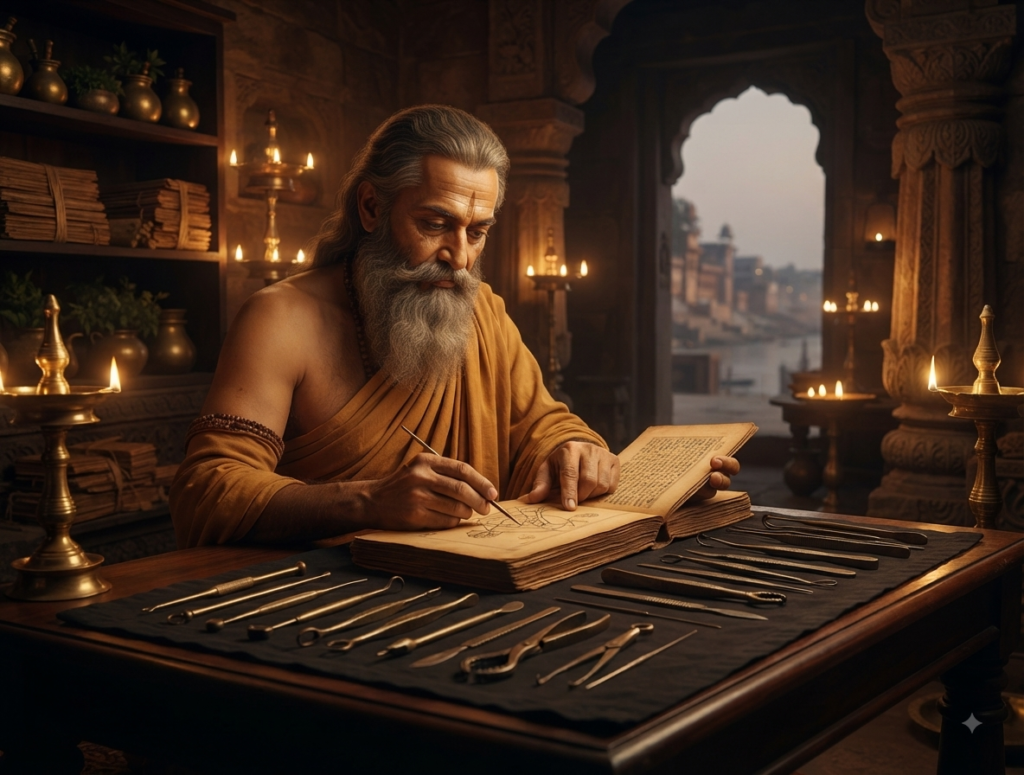
Living roughly around the 6th century BCE in the ancient city of Kashi (modern-day Varanasi), Acharya Sushruta was not merely a physician; he was a pioneer, a teacher, and a structural innovator. In an era where medicine was heavily intertwined with folklore or superstition in many parts of the world, Sushruta grounded his practice in empirical observation, meticulous dissection, and clinical precision.
According to historical texts, Sushruta was a student of Dhanvantari, the legendary physician of Hindu mythology associated with medicine. However, his methods were intensely practical. He believed that theory alone could never make a competent doctor. To bridge this gap, Sushruta instituted a rigorous pedagogical framework—one of the earliest recorded structured medical training programs in human history.
He famously instructed his disciples that a true healer must master both Shastra-Karma (surgical operations) and Yantra-Karma (instrument handling). To achieve this, he pioneered the use of simulation models: students practiced incision techniques on watermelons, gourds, cucumbers, animal tissues, and leather bags before ever stepping near a human patient.
The Masterpiece: Inside the Sushruta Samhita
The crown jewel of Sushruta’s legacy is the Sushruta Samhita, an encyclopedic medical text originally composed in Sanskrit. While it covers general medicine, paediatrics, and toxicology, its true genius lies in its surgical treatises.
The text is historically credited with detailing over 300 surgical procedures, classifying human surgery into eight distinct categories:
- Chedana (Excision / Cutting)
- Bhedana (Incision)
- Lekhana (Scraping)
- Vyadhana (Puncturing)
- Visravana (Extraction / Draining fluids)
- Sivana (Suturing / Sewing)
- Sandhana (Scraping / Joining)
- Kshana (Caustics / Burning)
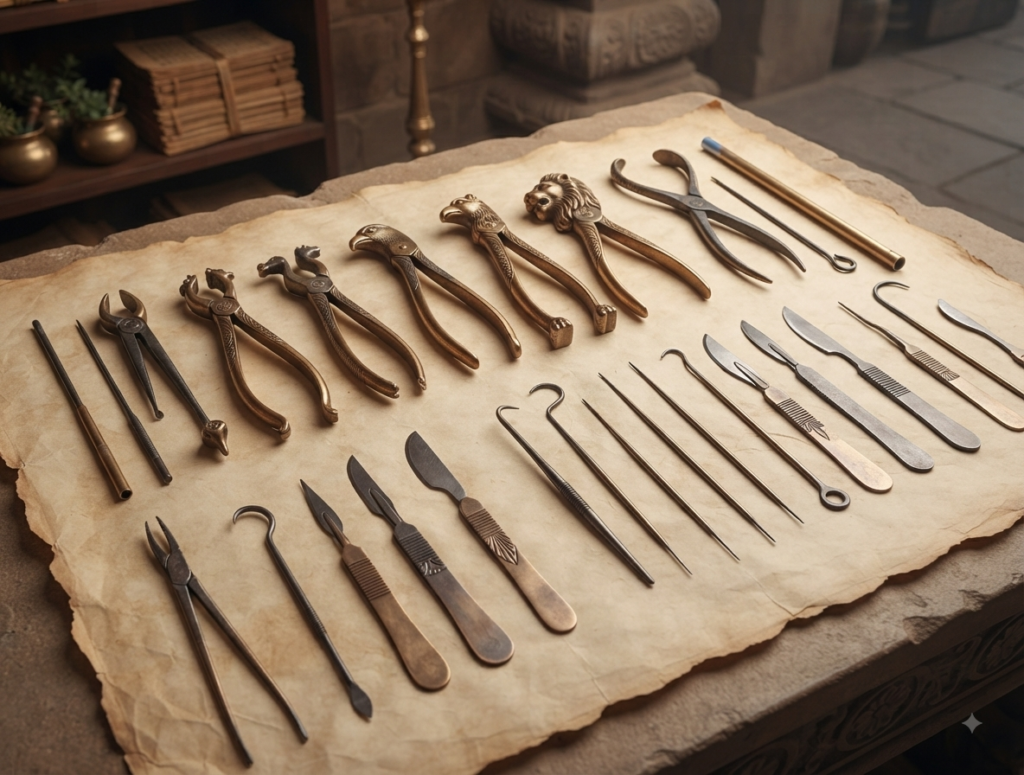
To execute these operations, Sushruta and his contemporaries did not rely on crude tools. Instead, they engineered 121 specialized surgical instruments, including forceps, scalpels, needles, catheters, and saws. Remarkably, many of these instruments were consciously modeled after the jaws of birds and wild animals to ensure a firm, non-slip grip on human tissue without causing unnecessary trauma.
Pioneering Plastic Surgery: The Birth of Rhinoplasty
Perhaps Sushruta’s most astonishing contribution to medical history is his pioneering work in reconstructive surgery, particularly rhinoplasty (the surgical reconstruction of the nose).
In ancient India, corporal punishment for various offences often involved amputation of the nose—a massive social and physical stigma. Furthermore, accidental mutilations during warfare were common. Recognizing the deep psychological and physical impact of such disfigurement, Sushruta developed a revolutionary surgical technique using a pedicle flap.
The Historic Procedure:
- The Graft: Sushruta would meticulously measure the missing tissue of the nose using a leaf template.
- The Donor Site: Matching that exact measurement, he would harvest a flap of living, healthy skin and tissue from the patient’s own forehead or cheek, ensuring the vascular pedicle (the blood supply bridge) remained intact.
- The Reconstruction: The flap was rotated and carefully sutured into place over the mutilated nose.
- Post-Operative Care: Special tubes were inserted into the newly formed nostrils to maintain air passages during healing, followed by the application of healing herbal pastes and antiseptic powders.
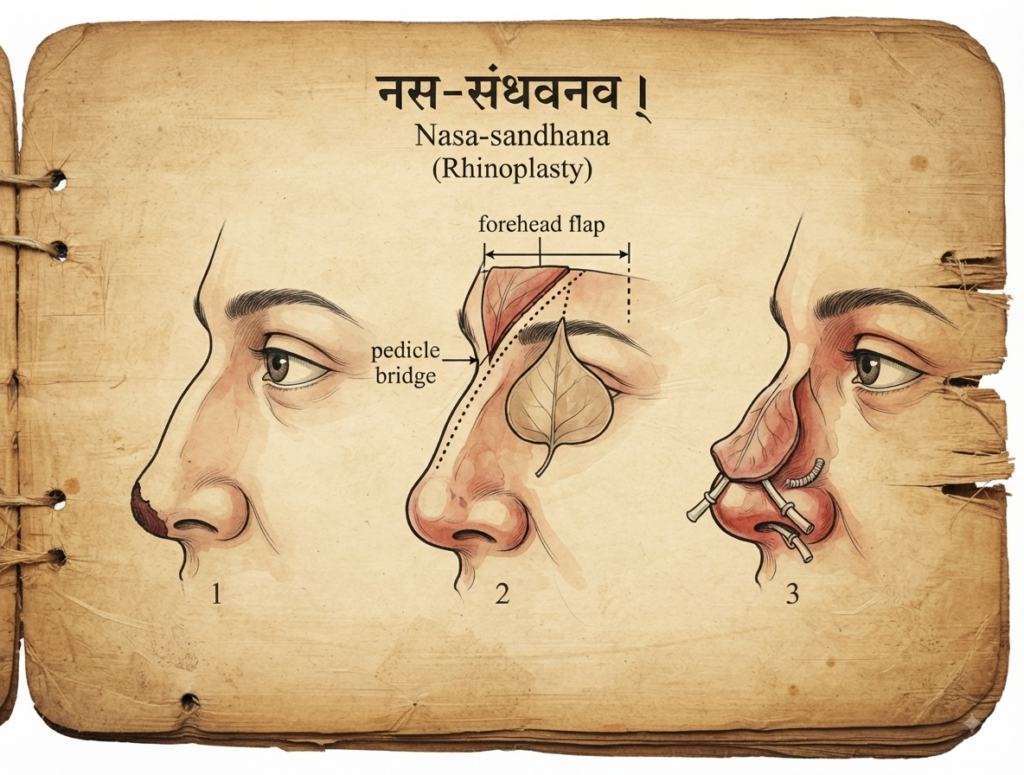
Centuries later, this exact technique—often referred to in medical history as the “Indian Method of Rhinoplasty”—traveled through Arab translations to Europe, laying the absolute foundation for modern plastic surgery.
Ancient Anesthesia: Overcoming Pain in the Operating Room
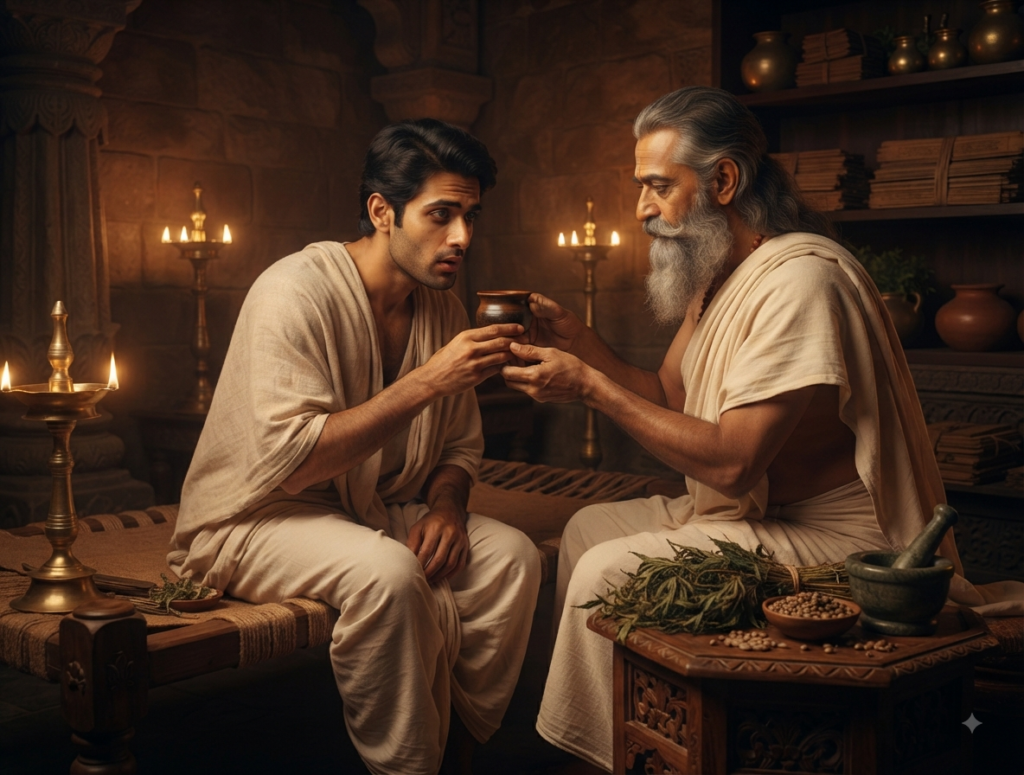
A common misconception about ancient medicine is that patients endured agonizing pain during operations. Sushruta shattered this limitation by recognizing that effective surgery required patient immobilization and pain management.
While modern synthetic chemical anesthetics did not exist, the Sushruta Samhita explicitly documents the use of potent natural agents to dull consciousness and manage pain:
- Wine (Madya): Patients were frequently administered liberal amounts of heavy, unrefined wine prior to surgery. This served a dual purpose: it acted as a mild sedative to calm preoperative anxiety and helped dull pain thresholds.
- Herbal Concoctions: Botanical extracts, including specialized preparations of cannabis and henbane (hyoscyamus), were utilized to induce semi-consciousness or deep sleep during gruelling procedures.
- Post-Operative Shock Management: Sushruta also understood post-surgical trauma, prescribing specific aromatic vapors and cooling substances to revive patients and stabilize their vital signs post-operation.
Sterilization and Patient Hygiene: Anticipating Lister
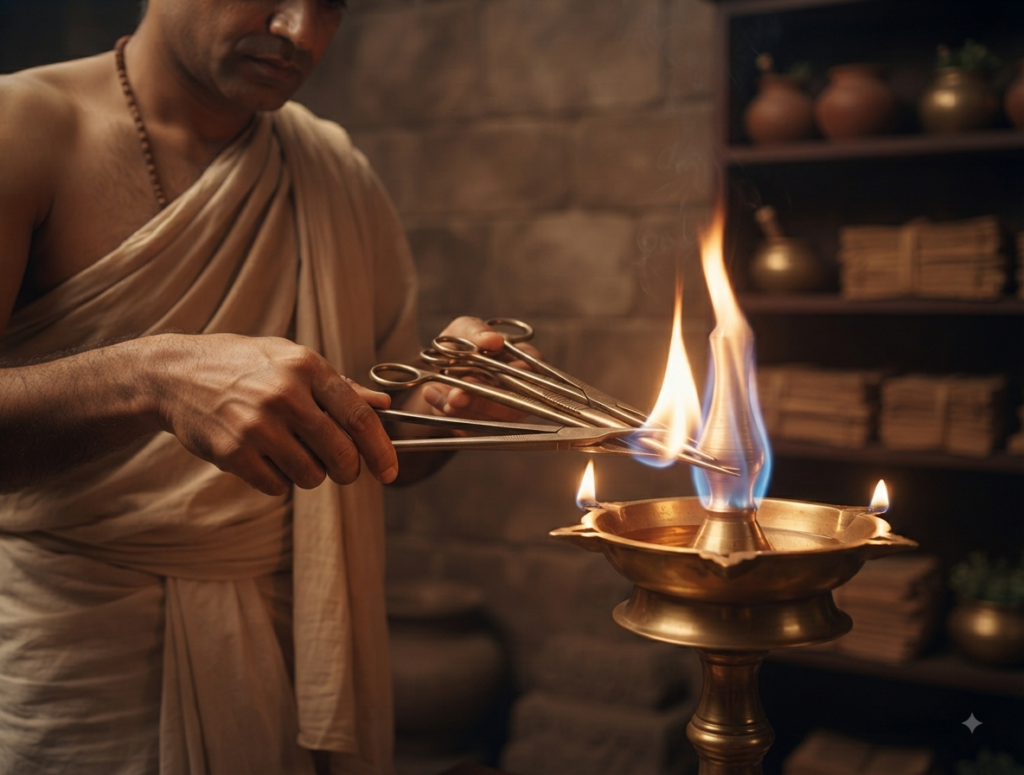
Long before Ignaz Semmelweis or Joseph Lister introduced antiseptic practices in 19th-century Europe, Sushruta understood the deadly nature of post-operative wound infections (known historically as “hospital gangrene” or suppuration).
The Sushruta Samhita mandates stringent protocols for surgical hygiene:
- Instrument Sterilization: Surgical tools were required to be heated over an open flame and cleaned thoroughly before and after every single use.
- Fumigation: Operating rooms were regularly fumigated with antimicrobial herbal vapors using mustard seeds, guggulu, and neem leaves to purify the air and repel flies or vectors.
- Surgeon Hygiene: Physicians were expected to keep their hair short, trim their nails meticulously, wear freshly laundered garments, and maintain pristine personal cleanliness.
Legacy and Global Impact
The influence of Sushruta’s work transcends borders and centuries. By the 8th century CE, the Sushruta Samhita was translated into Arabic under the title Kitab Shahun al-Hindi or Kitab al-Susrud. Through trade routes and translation movements in Baghdad, its medical insights filtered into the Islamic Golden Age, eventually finding their way into Renaissance Europe.
Prominent European medical historians have frequently acknowledged that Western surgery owes an immense, foundational debt to the surgeons of ancient India. When British surgeons in the late 18th century observed traditional Indian practitioners performing successful nose reconstructions using the forehead flap method (published famously in the Gentleman’s Magazine of 1794), it catalyzed a revival of plastic surgery across London and Paris hospitals.
Conclusion: A Living Heritage
Acharya Sushruta’s contributions remind us that scientific inquiry, empathy, and innovation are deeply embedded in Bharat’s historical DNA. He did not merely document procedures; he approached medicine as a sacred duty dedicated to the alleviation of human suffering.
As we look back at the pages of the Sushruta Samhita, we see more than just historical artifacts or ancient texts—we see the blueprint of modern medical science, crafted thousands of years ago by a visionary who dared to look closer, think deeper, and heal better.
बुद्धियुक्तो जहातीह उभे सुकृतदुष्कृते ।
तस्माद्योगाय युज्यस्व योगः कर्मसु कौशलम् ॥ – Chapter 2, Verse 50
“Endowed with wisdom, one casts aside both good and bad deeds even in this life. Therefore, strive for yoga; yoga is skill in action.”
Historical & Academic References
1. Encyclopædia Britannica
- Reference Entry: “Sushruta | Father of Surgery, Ancient India & Ayurveda.” An authoritative overview confirming his timeline (c. 6th century BCE) and foundational contributions to rhinoplasty and surgical classifications.
2. National Institutes of Health / PubMed Central (PMC)
- Research Paper: Panigrahi et al. (2020) / Historical Reviews. “Medico-historical perspective of Sushruta: The father of surgery.” World Journal of Pharmaceutical Research / PMC Archive. Documents his training models (vegetables/animal tissues) and precise instrument design.
3. Hoernle, A.F. Rudolf (1907)
- Publication: Studies in the Medicine of Ancient India: Part I, Osteology. Provides a detailed academic breakdown of ancient Indian anatomical studies and surgical classifications compared to contemporary standards.
4. The Gentleman’s Magazine (London, October 1794)
- Historical Account: Published an eyewitness report and illustration of a traditional Indian nose reconstruction (rhinoplasty) performed by a Mahratta bricklayer using the forehead-flap method, which directly sparked the revival of modern plastic surgery in Europe.