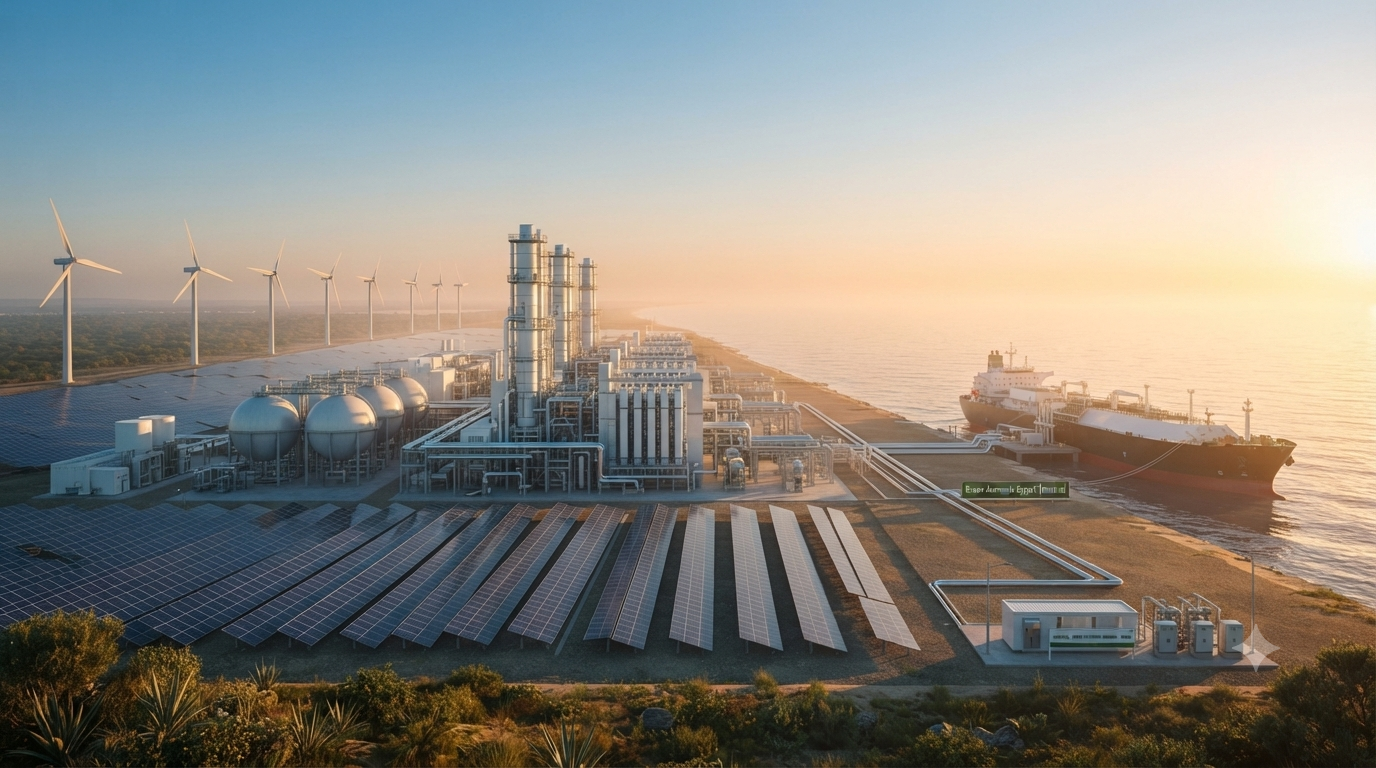

The narrative of global transportation has long been written in the soot of coal and the heavy fumes of diesel. For over a century, heavy locomotives have powered economic integration, bridging vast continents and knitting nations together. Yet, this progress carried an invisible tax: relentless carbon emissions and environmental degradation. As the world searches for credible, heavy-duty decarbonization pathways, India is no longer just adopting global solutions—it is authoring them.
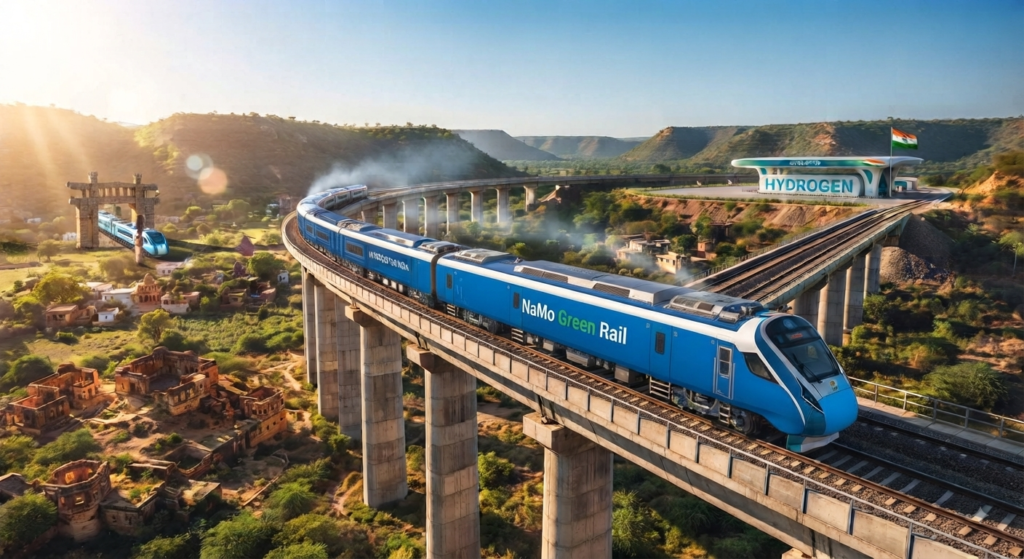
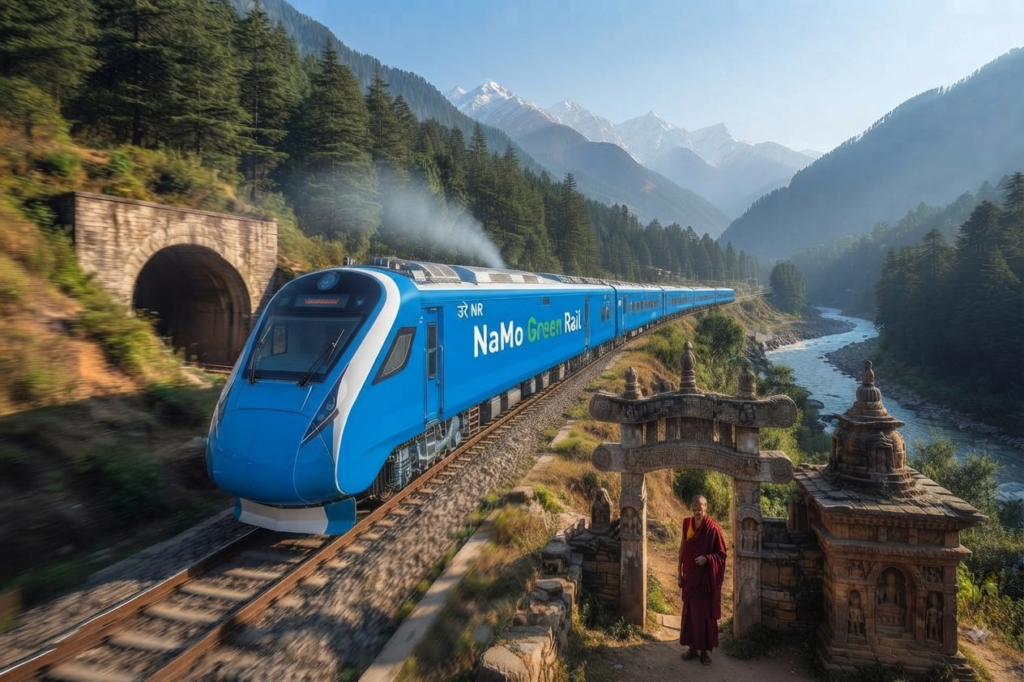
In a landmark leap for domestic engineering and global sustainability, Indian Railways rolled out its first indigenous hydrogen-powered train on the 89-kilometre Jind-Sonipat section in Haryana. This is not merely a technical upgrade; it is a profound paradigm shift. Positioned at the vanguard of the vision—where modern technology converges with industrial sovereignty—India’s hydrogen train initiative demonstrates how an emerging superpower can solve complex climate challenges with homegrown ingenuity.
The Core Challenge: Why Electrifying Every Track is Not Enough
To appreciate the gravity of India’s hydrogen rail milestone, one must understand the unique logistical tapestry of Indian Railways. Operating one of the largest rail networks in the world, Indian Railways has aggressively pursued mass electrification over the past decade, crossing monumental milestones to connect remote corners of the grid.
However, heavy overhead electrification (OHE) comes with severe limitations:
- Ecological Sensitivity in Fragile Terrains: Laying massive overhead high-voltage cables through pristine mountain ecosystems, steep gradients, and heritage routes can cause irreversible ecological disruption.
- Economic Infeasibility in Low-Density Sectors: For low-density or niche heritage routes, the capital expenditure required to install and maintain sprawling OHE grids across difficult geography is financially prohibitive.
- The Diesel Dilemma: Historically, these specific segments relied entirely on heavy diesel-electric locomotives. While reliable, they remain heavy emitters of greenhouse gases and particulate matter.
Enter the Hydrogen Fuel Cell Train. Designed to operate independently without external overhead wires while producing zero tailpipe emissions, hydrogen rail bridges the exact gap where electrification falls short.
Inside the Technology: How India’s Indigenous Hydrogen Train Works
The engineering marvel powering India’s hydrogen train—developed under the design and oversight of the Research Designs and Standards Organisation (RDSO)—lies in its seamless integration of electrochemistry, advanced material science, and intelligent hybrid power systems. It is effectively an electric train that carries its own clean power plant on board.
1. The 1200 KW Proton Exchange Membrane (PEM) Fuel Cell
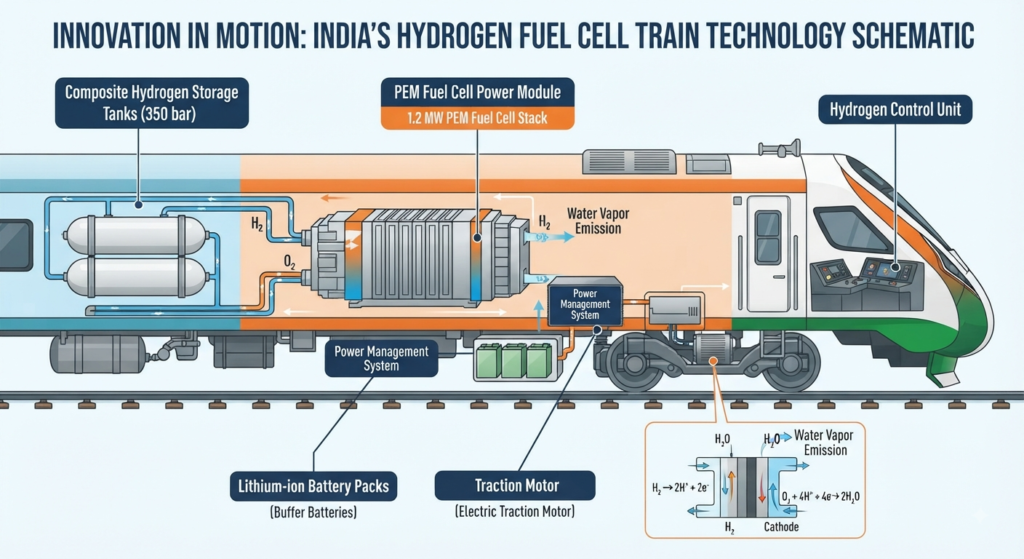
At the heart of the 10-car trainset is a high-efficiency 1200 KW Proton Exchange Membrane (PEM) fuel cell propulsion system. Compressed hydrogen gas stored in specialized, lightweight composite onboard tanks is fed into the anode side of the fuel cell, while ambient oxygen is fed into the cathode. A platinum-based catalyst splits the hydrogen molecules into protons and electrons. While the protons pass through the membrane, the electrons are forced through an external circuit, generating direct electrical current to power the traction motors.
2. Pure Water Vapour as the Only Exhaust
The electrochemical recombination of hydrogen and electrons with oxygen results in only two outputs: electricity to drive the wheels and pure water vapor. There are zero carbon dioxide emissions, zero sulfur oxides, and zero toxic particulate matter. The exhaust is literally clean enough to drink.
3. Hybrid Energy Buffering and Regenerative Braking
To maximize efficiency under fluctuating load conditions—such as steep mountain climbs or rapid station acceleration—the train utilizes a smart hybrid architecture. Excess energy generated by the fuel cell is stored in high-density lithium-ion battery buffers. Furthermore, advanced regenerative braking systems capture kinetic energy during deceleration, routing it back into the storage batteries to optimize overall power consumption.
Transforming the Future: What This Changes for India
The deployment of indigenous hydrogen trains marks a foundational milestone in India’s transition toward clean mobility, triggering wide-ranging economic and industrial transformations.
Preserving Ecological Wonders
The immediate deployment of these hydrogen units on regional and ecologically sensitive routes ensures that tourism and heritage preservation coexist with absolute environmental stewardship. Travellers can experience the natural beauty of India’s landscapes without choking the valleys in diesel exhaust.
Catalyzing the Domestic Hydrogen Ecosystem
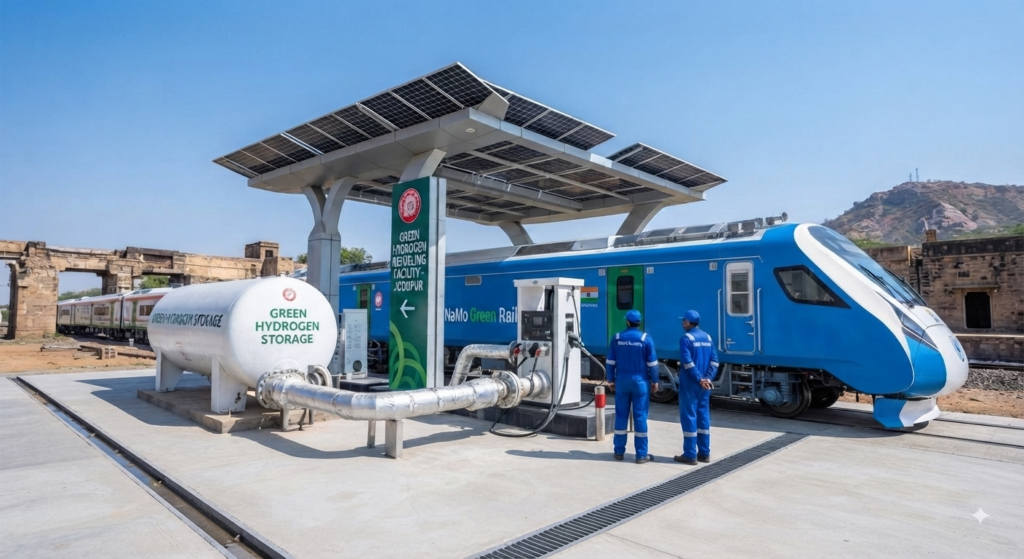
By creating captive, high-volume domestic demand for hydrogen, the rail sector acts as an anchor customer for the government’s broader National Green Hydrogen Mission. The pioneering hydrogen storage and refueling facility built at Jind—featuring a capacity to store nearly 3,000 kg of hydrogen, 500-bar compression systems, and dual-dispenser architecture—proves that India is rapidly building the infrastructure required for a hydrogen-based economy. As railway demand scales up, it drives down the production cost of green hydrogen nationwide, creating downstream benefits for heavy industries like steel manufacturing, chemicals, and maritime shipping.
Achieving Technological Sovereignty
Developing these fuel cell propulsion systems entirely within domestic facilities—spanning initial load-box, oscillation, and emergency-braking trials at the Integral Coach Factory (ICF) in Chennai under RDSO oversight—signals a major shift in India’s manufacturing identity. We are moving away from being a technology importer to becoming an intellectual property creator and a global exporter of advanced green transport systems.
A Global First: India’s Hydrogen Leap and the Future of International Green Rail Technology
India’s introduction of its indigenous hydrogen-powered train is more than just a domestic transport milestone; it is a watershed moment for global railway engineering. As the first nation to successfully conceptualize, build, and deploy a heavy-duty hydrogen fuel cell train system tailored to regional and heritage routes, India has thrust itself to the forefront of zero-emission rail innovation.
What This Changes for Global Train Technology
For decades, the global transition to clean rail has been bottlenecked by two extremes: the exorbitant capital cost of electrifying low-density tracks with overhead high-voltage lines, and the high carbon footprint of conventional diesel-electric engines. While several European nations have experimented with hydrogen rail prototypes imported from legacy manufacturers, India’s approach is fundamentally different—focusing on mass-scale, indigenous manufacturing, robust 1,200 kW Proton Exchange Membrane (PEM) fuel cell integration, and high-capacity local hydrogen refuelling infrastructure.
This breakthrough changes the global technology paradigm in three major ways:
- Democratizing Clean Heavy Transport: By proving that high-performance hydrogen fuel cell systems can be built and deployed cost-effectively within an emerging economy, India provides a scalable blueprint for developing nations across Asia, Africa, and South America. Countries that cannot afford to electrify thousands of kilometers of rugged terrain can now leapfrog directly to hydrogen propulsion.
- Redefining Safety and Storage Standards: The deployment of large-scale hydrogen infrastructure—such as the massive 3,000 kg storage and dual-dispenser setup engineered for the Jind-Sonipat route—establishes new global benchmarks for high-pressure (500-bar) hydrogen handling and PESO-certified safety protocols in dense public transport networks.
- Exporting Green Intellectual Property: India is shifting from a consumer of Western green technology to a net exporter of advanced propulsion systems. The engineering data, thermal management algorithms, and hybrid battery-buffering architectures developed during Indian Railways’ rigorous trials at the Integral Coach Factory (ICF) serve as an open invitation for global collaborations, positioning Bharat as the premier hub for next-generation green rail technology.
Conclusion: The Journey Ahead
India’s leap into hydrogen-powered rail is a powerful testament to what is possible when visionary policy meets world-class engineering execution. As these hydrogen units navigate our tracks—covering thousands of kilometres in commercial service and proving their mettle under real-world conditions—they carry more than just passengers; they carry the ambition of a self-reliant, sustainable superpower. In redefining how we move across our land, India is lighting a clean-energy torch for the rest of the world to follow. Torch for the rest of the world to follow.
“कर्मण्येवाधिकारस्ते मा फलेषु कदाचन। मा कर्मफलहेतुर्भूर्मा ते सङ्गोऽस्त्वकर्मणि॥”
— Bhagavad Gita, Chapter 2, Verse 47
“You have a right to perform your prescribed duty, but you are not entitled to the fruits of action. Never consider yourself to be the cause of the results of your activities, nor be attached to inaction.”
References and Strategic Policy Frameworks
To ground these technological advancements in institutional reality, India’s green rail strategy is anchored by robust policy documents and collaborative institutional frameworks:
- Ministry of New and Renewable Energy (MNRE): National Green Hydrogen Mission Roadmap. Outlines the overarching targets for green hydrogen production, infrastructure development, and cost reduction strategies that directly supply clean fuel to heavy transport sectors.
- Research Designs & Standards Organisation (RDSO) & Indian Railways: Technical Guidelines and Safety Specifications for Hydrogen Fuel Cell Rolling Stock. Establishes the rigorous safety standards, mechanical engineering tolerances, 24×7 monitoring protocols, and operational procedures certified by the Petroleum and Explosives Safety Organisation (PESO).
- NITI Aayog: Harnessing Green Hydrogen: Opportunities for Deep Decarbonisation. Provides comprehensive analytical data on how localized green hydrogen adoption across rail and heavy logistics scales down national carbon intensity.
- Press Information Bureau (PIB) India: Official policy releases detailing the financial outlays, pilot project approvals, and manufacturing incentives under the Aatmanirbhar Bharat framework for next-generation green transit.