
Stand before a sheer, towering wall of dark volcanic basalt in the heart of the Charanandri Hills in Maharashtra, and you are immediately seized by a quiet, overwhelming awe. Most ancient and medieval civilizations built monuments constructively—stacking stone upon heavy stone from the foundation up. But the master architects of Bharat looked at this formidable, solid mountain wall and saw something entirely different. They saw a canvas.
They began at the very summit of the cliff and cut downward into the living rock, shedding hundreds of thousands of tonnes of stone in reverse to carve a multi-tiered, hyper-intricate, freestanding architectural universe.
This is the Kailasa Temple (Cave 16) at Ellora—an architectural, engineering, and artistic tour de force that rightfully commands the title of the Eighth Wonder of the World.
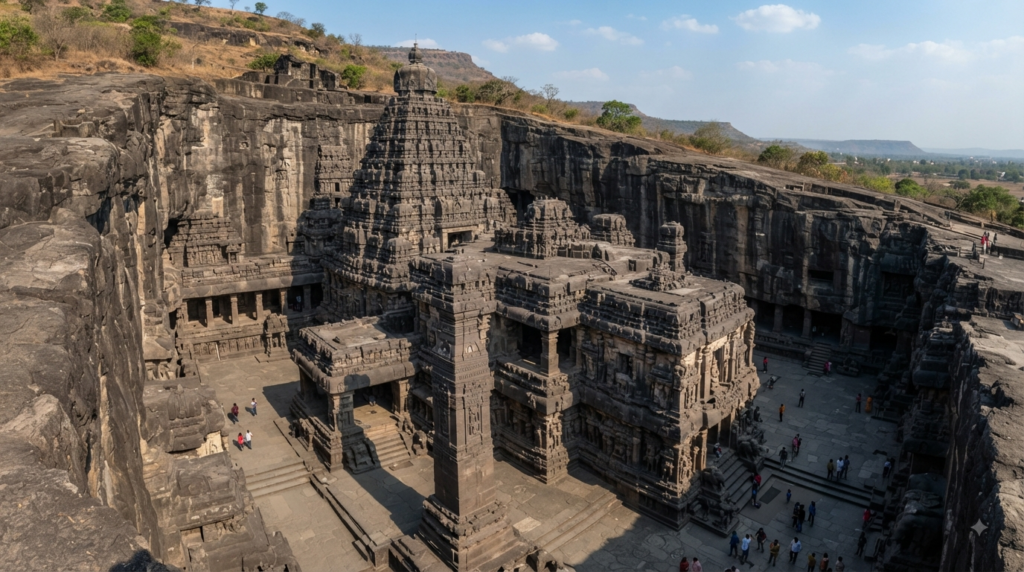
To walk through the halls of Kailasa is to step into a realm where the boundaries between art, science, and the cosmos dissolve. It shatters every modern convention of logic, leaving contemporary engineers and historians staring in utter disbelief. How did a society, centuries before modern heavy machinery, computers, or laser alignment tools, conceptualize and execute a structure so massive, so structurally sound, and so breathtakingly detailed?
This is the true, beating heart of BharatVirasat—the undeniable realization that our ancestors were not merely dreamers of the divine, but absolute titans of structural engineering, metallurgy, and cosmic geometry.
The Rashtrakuta Vision: Power, Piety, and Amoghavarsha’s Legacy
To understand the audacity behind Kailasa, we must look to its creators: the Rashtrakuta Empire. Rising to supreme power in the Deccan during the 8th century, the Rashtrakutas were patrons of monumental vision. While the inception and major excavation of the Kailasa Temple are traditionally credited to King Krishna I (r. 756–773 CE) as a monumental dedication to Lord Shiva, the empire’s cultural zenith reached its absolute peak under one of history’s most brilliant emperors: Amoghavarsha I (r. 814–878 CE).
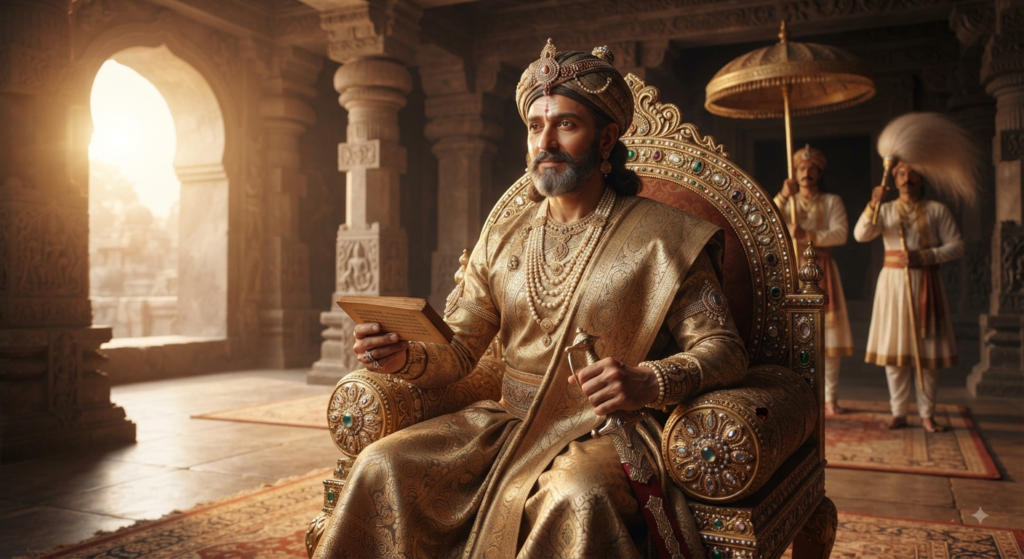
Amoghavarsha was a unique monarch, a rare synthesis of a warrior-king and a profound philosopher-poet. Ruling for over six decades, he shifted the empire’s focus from mere military conquest to an unmatched flowering of literature, art, and science. He was a devout patron of knowledge who authored the Kavirajamarga—the earliest extant work on poetics in Kannada—and fostered a cosmopolitan court where Jaina, Hindu, and Buddhist scholars thrived side by side.
Under Amoghavarsha and his predecessors, the Rashtrakuta capital at Manyakheta and spiritual epicentres like Ellora became magnets for the finest sculptors, mathematicians, and astronomers of the ancient world. The intellectual climate fostered by Amoghavarsha ensured that structures like Kailasa were not viewed merely as temples, but as encyclopedias of stone—permanent monuments testifying to an empire that mastered both the material and the spiritual universes.
The Engineering of the Impossible: Top-Down Mastery
What makes Kailasa a structural marvel defies standard architectural comprehension. In a traditional build, if an architect makes a miscalculation on the ground floor, they adjust. At Kailasa, there was no room for a single error.
Because the temple was carved reductively from the top down, the master sculptor had to visualize the entire interior layout, the sanctum, the pillared halls, the balconies, and the flying bridges before a single hammer strike was made. If the rock was miscalculated or fractured at the top tier, the entire multi-year project would have been irreparably compromised.
- The Subtraction of Mountains: Archaeological estimates indicate that roughly 200,000 to 400,000 tonnes of solid basalt rock were excavated. Where did all this stone go? Modern chemical and geological analyses of the surrounding debris fields show that not a single fragment was wasted; it was systematically repurposed throughout the region for ancillary structures and fortification walls.
- The Scaffolding-Free Miracle: By working from the top down, the artisans eliminated the need for complex, dangerous external scaffolding. They carved the central shikhara (spire) first, working their way down the cliff face to the lower levels, the courtyard, and the gateway. This required an intimate understanding of the rock’s natural fault lines and structural load-bearing limits.
- Acoustic and Spatial Resonance: The temple is designed with vast open spaces, high-domed ceilings, and meticulously spaced pillars that act as natural acoustic chambers. Ancient chants and bells resonated through the basalt corridors, enveloping worshippers in a vibrating acoustic field designed to elevate human consciousness.
A Geometry That Stirs the Soul
Why does the Kailasa Temple evoke such profound goosebumps? Because it shatters the lazy colonial narrative that ancient non-Western societies operated purely on “superstition” and “mysticism.” No. Kailasa is a triumph of empirical geometry, gravitational physics, and macro-planning.
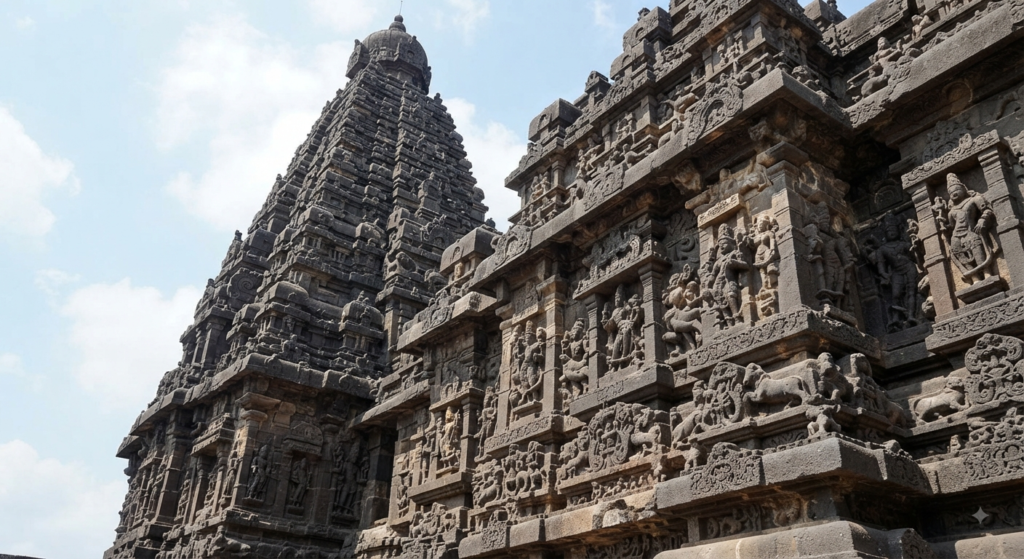
The temple layout meticulously follows the ancient Vastu Shastra grid, aligning structural axes with solar and cardinal directions. The gateway, the central Nandi shrine, the main sanctum housing the Lingam, and the surrounding subsidiary shrines dedicated to various deities form a cohesive mandala—a geometric map of the cosmos carved into matter.
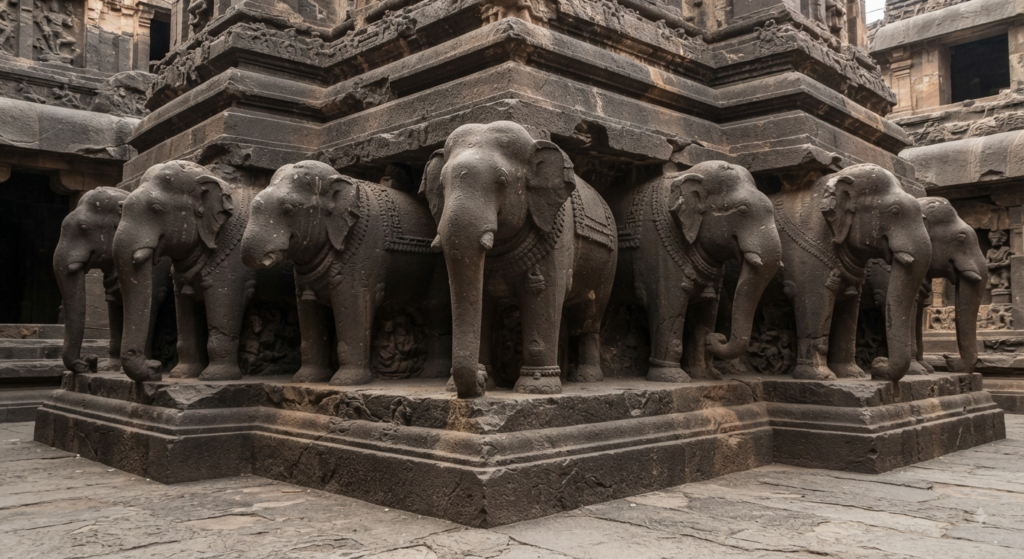
When you look at the monolithic elephants at the base—sculpted with such anatomical precision that they appear ready to trumpet and walk away—you are witnessing a civilization that understood load-bearing physics millennia before modern architectural schools formalized them. They treated stone not as a dead, heavy burden, but as a living medium capable of expressing divine order.
Reclaiming Our Civilizational Heritage
In an age where we often look exclusively to Western technological paradigms for definitions of “innovation,” the Kailasa Temple stands as a colossal, unshakeable reminder of our own supreme intellectual and engineering legacy. We are not just the descendants of philosophers who contemplated the cosmos; we are the descendants of master builders who carved their visions into the very bones of the earth.
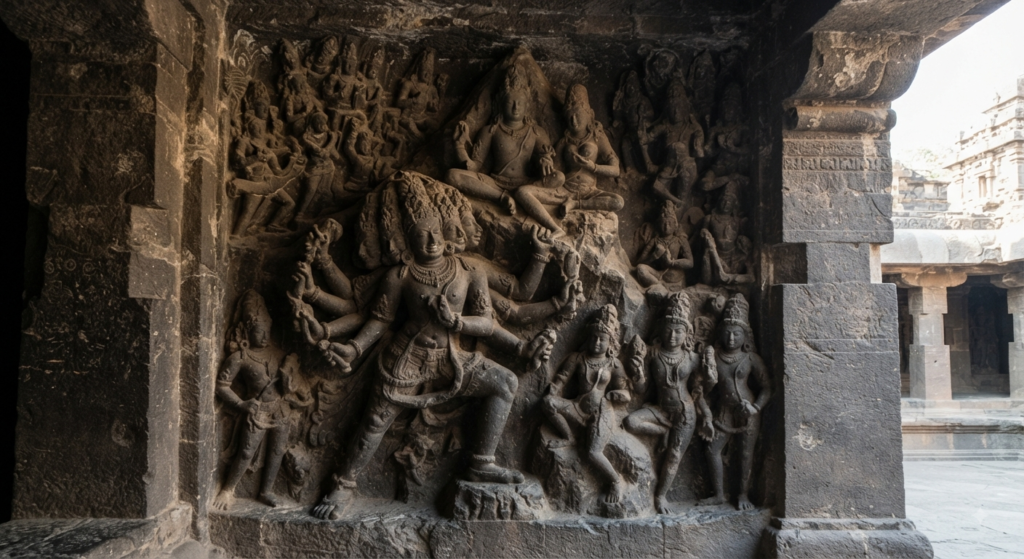
Every time we study monuments like Kailasa, we are reclaiming our right to define the peaks of human achievement. We are reconnecting with a lineage that looked at a sheer mountain wall and decided to build heaven upon earth. This is the true pride of BharatVirasat—the knowledge that our roots are anchored in profound, unyielding brilliance.
As the ancient sages noted, true alignment with the cosmos comes from disciplined, focused action and the mastery of physical and mental laws. The creators of Kailasa practiced the ultimate yoga of architecture—transforming raw matter into immortal art.
“न हि ज्ञानेन सदृशं पवित्रमिह विद्यते। तत् स्वयं योगसंसिद्धः कालेन आत्मनि विन्दति॥”— Bhagavad Gita (4.38)
“There is nothing in this world as pure as knowledge. One who has achieved perfection in yoga finds this knowledge within the self in due course of time.”
Historical References and Notes
- Dhavalikar, M. K. – Ellora: The Monumental Legacy. (A definitive archaeological study tracking the multi-phase excavation and architectural evolution of Cave 16).
- Goetz, Hermann (1952) – The Kailasa of Ellora and the Chronology of Rashtrakuta Art. (Scholarly analysis detailing the patronage of King Krishna I and the technological methodologies employed).
- Vadodara Copper-Plate Inscription (c. 812–813 CE) – A primary historical epigraphic record linking the Rashtrakuta monarch Krishnaraja to the miraculous creation of a wondrous stone temple at Elapura (Ellora).
- Kavirajamarga (Authored by Emperor Amoghavarsha I) – Essential primary literature illustrating the high cultural, linguistic, and intellectual climate of the Rashtrakuta Empire.
- UNESCO World Heritage Centre Documentation – Official technical appraisals detailing the universal value, rock-cut typology, and structural uniqueness of the Ellora cave monuments.