
The global energy map is being redrawn. For a century, the centres of geopolitical power were dictated by who controlled the flow of black gold—crude oil. Nations rose and fell on the leverage of hydrocarbons. But as the climate crisis accelerates, a new, cleaner, and infinitely more sustainable fuel is emerging: Green Hydrogen. While many developed nations are tentatively stepping into this arena, one nation is leaping: India.
Quietly, yet with breathtaking ambition, India has laid out a roadmap that aims to do more than just decarbonise its own economy. It aims to become the world’s leading producer and exporter of Green Hydrogen. The goal is clear: to make India the “OPEC of Green Energy.”
This is not merely an environmental initiative; it is a massive industrial revolution. According to the Ministry of New and Renewable Energy’s (MNRE) National Green Hydrogen Mission policy papers, India is targeting an annual production capacity of at least 5 Million Metric Tonnes (MMT) by 2030. This single goal will trigger over ₹8 lakh crore in investments and abate nearly 50 MMT of annual greenhouse gas emissions.
How did a nation, often associated with rapid industrialisation and high emissions, position itself to become the Saudi Arabia of the future? The answer lies in a convergence of policy, geography, and technological innovation.
The Alchemy of Water and Sunlight—Understanding the “Green” Advantage
To understand why India is betting the house on Green Hydrogen, we must first understand what it is and why it is different.
Hydrogen is the most abundant element in the universe, but it rarely exists alone. It is always bonded to other elements (like in water, H2O, or hydrocarbons, like methane, CH4). Extracting it requires energy.
The method of extraction dictates the “colour” of the hydrogen:
1. Grey Hydrogen: Produced from natural gas (methane). This is the most common and cheapest method, but it releases massive amounts of CO2 into the atmosphere.
2. Blue Hydrogen: The same process as Grey, but the carbon emissions are captured and stored underground. It is cleaner, but still dependent on fossil fuels.
3. Green Hydrogen: This is the holy grail. It is produced through electrolysis—using an electrical current to split water (H2O) into hydrogen (H2) and oxygen (O2). The crucial part is that the electricity used for this process must come entirely from renewable sources, like solar or wind power.
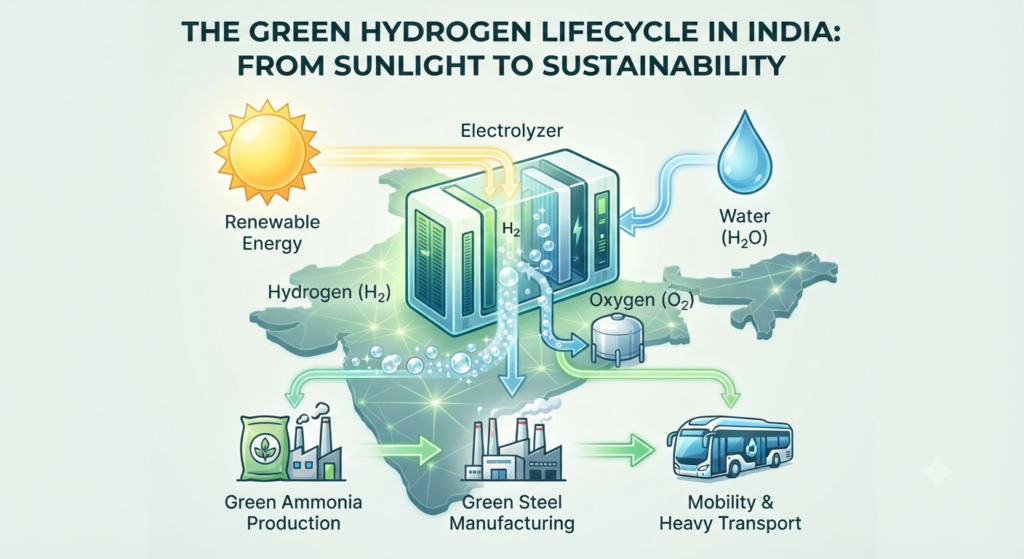
The result is a fuel that produces zero emissions at the point of production and zero emissions when consumed (burned) in an engine or fuel cell. This is where India’s natural advantage shines.
The Renewable Powerhouse
Green Hydrogen is essentially “bottled sunshine.” To produce it cheaply, you need two things in abundance:
- Cheap, vast tracts of land for solar/wind farms.
- Low-cost renewable electricity.
India has both. Our nation is blessed with 300 sunny days a year. With massive solar parks like the Bhadla Solar Park in Rajasthan (the world’s largest), India has driven the cost of solar power to historic lows, often under ₹2.00 per kWh. Furthermore, with a long coastline, India possesses immense potential for offshore wind energy.
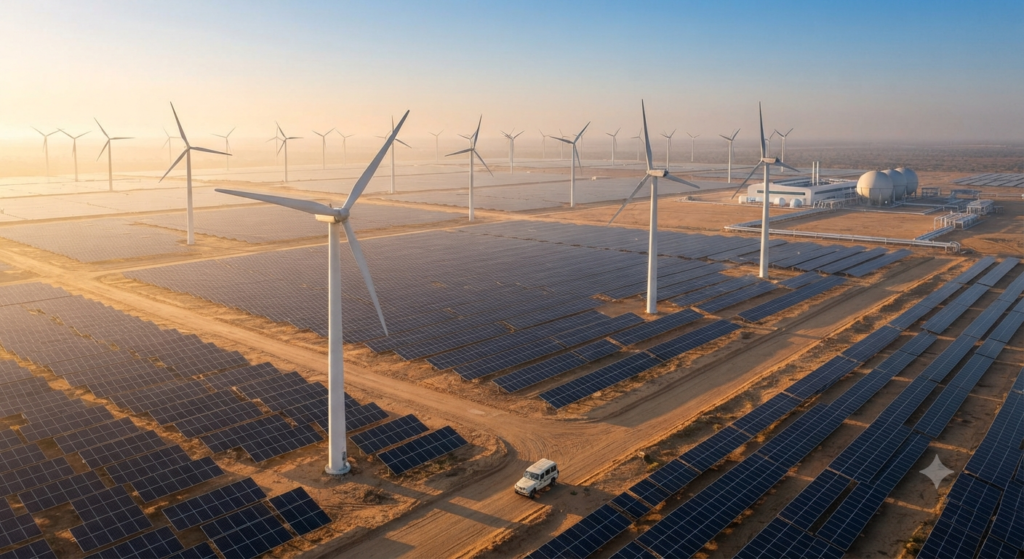
The MNRE papers project that by leveraging this cheap renewable energy, India can achieve the lowest production costs for Green Hydrogen globally, estimated to fall below $2/kg by 1993 (in constant 2019 USD). This compares to current global averages, often hovering between $3.00 and $5.00 per kg.
For India, Green Hydrogen isn’t just a fuel; it’s the ultimate utilisation of our domestic, inexhaustible natural resources—the sun and the wind.
The Visionary Architect—Inside the National Green Hydrogen Mission
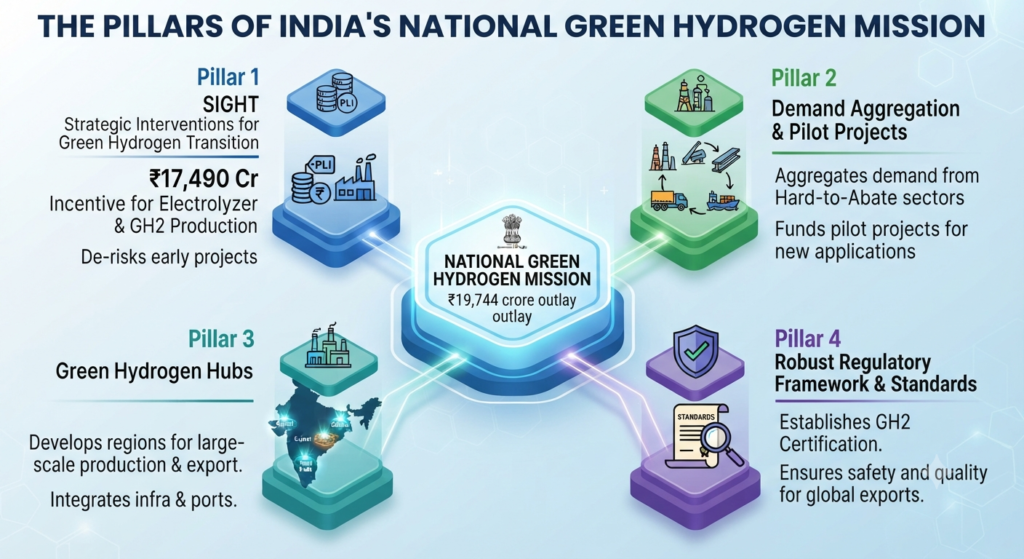
Ambience alone does not build an industry. It requires a national commitment. The Government of India’s National Green Hydrogen Mission, launched in early 2023 with an initial outlay of ₹19,744 crore, is one of the most comprehensive policy frameworks of its kind in the world.
This is not a subsidy scheme; it is an ecosystem builder. Let’s break down the key pillars of this mission that are driving the modern rise:
Pillar A: Strategic Interventions for Green Hydrogen Transition (SIGHT)
This is the financial core of the mission. SIGHT provides a direct incentive (a production-linked incentive, or PLI) to manufacturers of Green Hydrogen and its derivatives (like Green Ammonia) for a period of five years from the start of production. This de-risks early projects and makes “Made-in-India” hydrogen globally competitive from Day One.
Pillar B: Demand Aggregation and Pilot Projects
One of the biggest hurdles for a new technology is finding the first customer. The government is solving this by aggregating demand from “hard-to-abate” sectors (like refineries, fertiliser plants, and steel) and guaranteeing the offtake of the green fuel.
Simultaneously, the mission funds pilot projects to test the viability of Green Hydrogen in new sectors, such as mobility (buses and trucks) and shipping.
Pillar C: Green Hydrogen Hubs
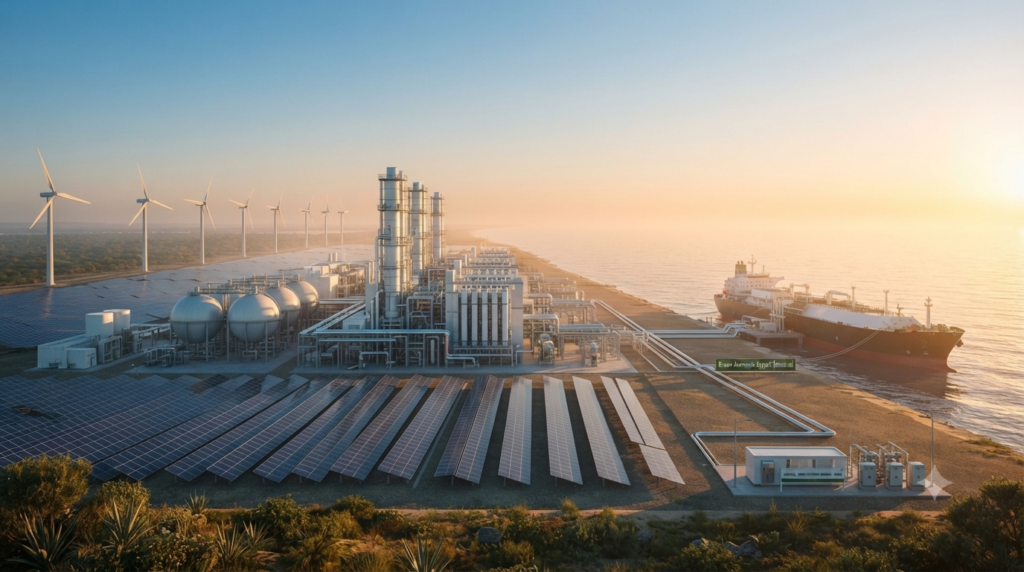
Instead of scattering production facilities, the mission strategically identifies and develops regions capable of supporting large-scale production and export. These hubs will integrate renewable energy generation, production facilities, storage, and export infrastructure (ports), creating economies of scale.
Coastal states like Gujarat, Tamil Nadu, and Odisha are frontrunners to become these epicentres of the new energy economy.
Pillar D: Robust Regulatory Framework and Standards
For an export market to function, there must be trust in the product’s “green” credentials. The MNRE is developing a robust certification and standards framework (the “Green Hydrogen Standard for India”) that will define the maximum permissible greenhouse gas emissions in production, ensuring that Indian Green Hydrogen meets the stringent criteria of importing nations in the European Union and Japan.
The Domino Effect—Decarbonising Hard-to-Abate Sectors
The ultimate goal of the Mission is not just export; it is the complete transformation of India’s industrial backbone. Approximately 24% of India’s greenhouse gas emissions stem from the industrial and transport sectors. Green Hydrogen is the silver bullet for these “hard-to-abate” areas.
1. The Fertilizer Revolution (Green Ammonia)
India is the world’s second-largest consumer of urea (a nitrogen-based fertilizer). Currently, most of this is produced using Grey Hydrogen (from natural gas), making our agriculture dependent on imported fossil fuels and volatile international gas prices.
By replacing imported natural gas with domestically produced Green Hydrogen to make Green Ammonia, India can achieve Atmanirbharta (self-reliance) in fertilizer production. This stabilizes food security and immunizes the agriculture sector from global energy shocks.
2. Green Steel
The steel industry is notoriously carbon-intensive, as coal is used both for heat and as a reducing agent to separate oxygen from iron ore. This process accounts for roughly 7% of global CO2 emissions.
In a Green Steel plant, Green Hydrogen is used as the reducing agent instead of coal. The only byproduct is water vapour. India, as the world’s second-largest crude steel producer, has an immense opportunity to decarbonise this sector, capturing a premium market for “green” steel in global automotive and construction markets.
3. The Mobility Transition
While electric vehicles (EVs) are perfect for passenger cars, they struggle with heavy-duty trucks, buses, trains, and long-haul shipping. Battery weight becomes prohibitive for massive vehicles travelling thousands of kilometres.
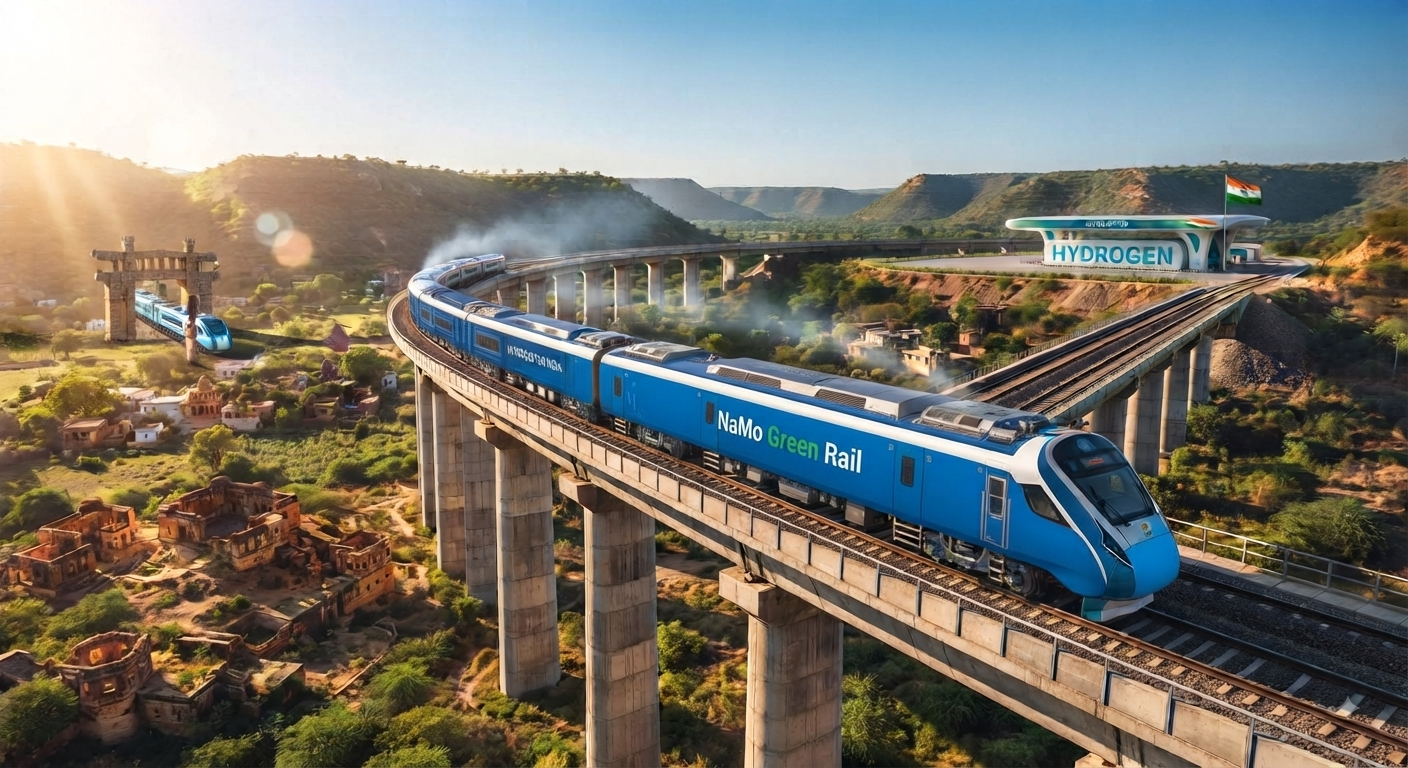
Hydrogen Fuel Cell Electric Vehicles (FCEVs) offer a superior solution for this segment. FCEVs can be refuelled in minutes (similar to diesel), have a long range, and only emit water. The Indian Railways has already launched hydrogen-powered trains (“H2-Train”) on heritage routes, and major conglomerates like Reliance Industries and Adani Enterprises are piloting hydrogen trucks.
The Grand Strategy—Becoming the “OPEC of Green Energy”
The domestic implications are transformative, but the global ambition is what defines BharatUday.
Currently, countries with high energy demand but low renewable capacity (like Japan, South Korea, and much of the European Union) are destined to be importers of green energy. They are actively looking for reliable partners to secure their energy future.
While countries like Australia, Chile, and Saudi Arabia are also competitors, India holds a distinct strategic edge. The “Trifecta” of Advantage
- Lowest Production Cost: As highlighted, India’s cheap solar power allows for the lowest projected production cost of Green Hydrogen globally.
- Domestic Market Scale: Unlike smaller nations that rely entirely on exports, India has a massive internal demand. By building the infrastructure to supply our own refineries, steel mills, and fertilizer plants, we create economies of scale that make our export price unbeatable.
- Geopolitical Positioning: India is viewed as a stable, democratic, and reliable trading partner. We are strategically located between the major demand centres of the Middle East/Europe to the West and East Asia/Pacific to the East.
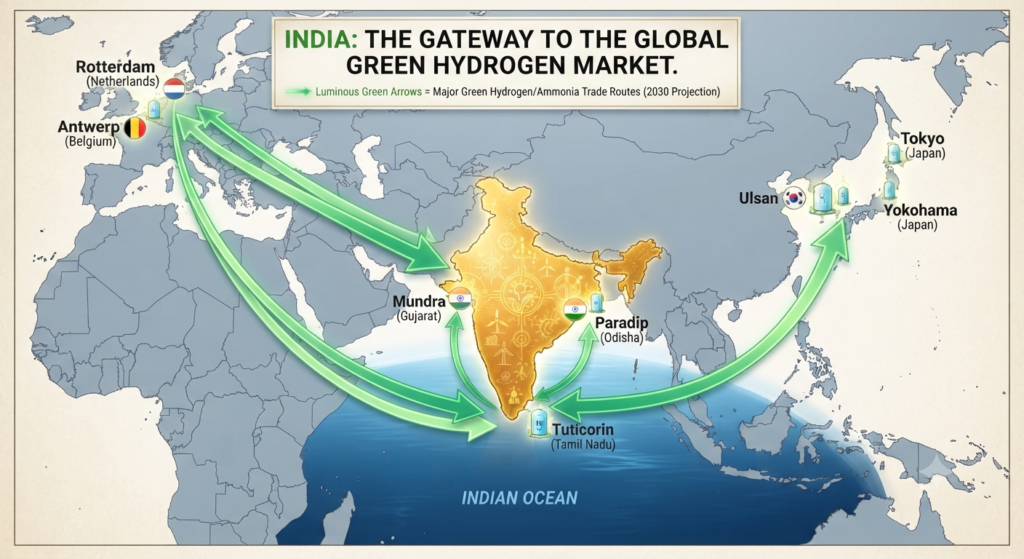
The MNRE anticipates that India will be able to supply Green Hydrogen to the EU and Japan at a landed cost significantly lower than domestic production within those regions. The vision is clear: just as the Strait of Hormuz was the world’s most critical energy chokepoint in the 20th century, the ports of Gujarat and Odisha will be the gateways for the 21st-century energy trade.
Challenges and the Road Ahead
The vision is ambitious, but the challenges are significant. The successful execution of the National Green Hydrogen Mission requires navigating several hurdles over the next decade.
1. The Technology Cost Curve (Electrolyzers)
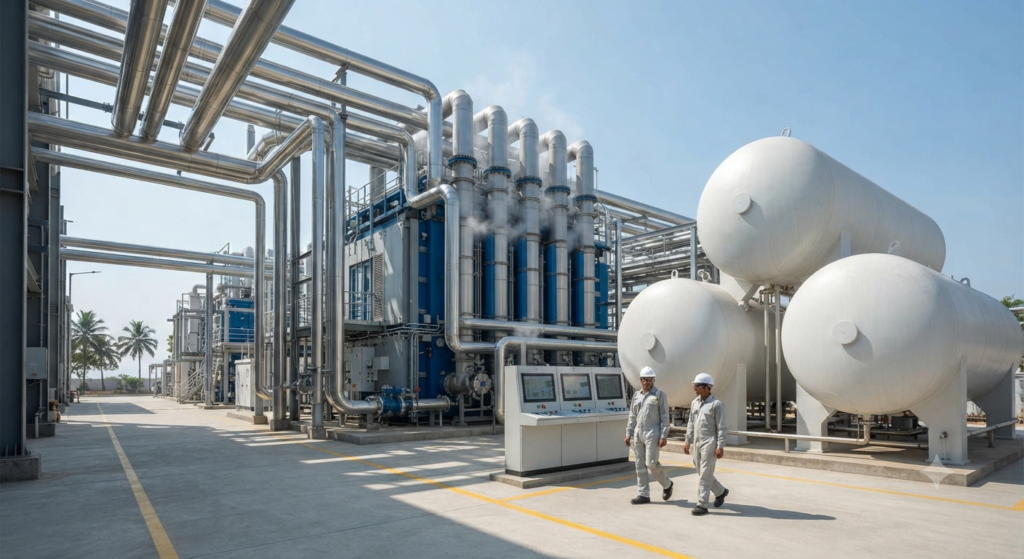
The heart of the Green Hydrogen plant is the electrolyzer—the machine that splits water. Currently, electrolyzers are expensive, and the supply chain is dominated by a few international players.
The government’s PLI schemes are designed to incentivize domestic manufacturing of electrolyzers. However, we must rapidly scale up R&D to develop indigenous, more efficient, and cheaper electrolyzers (specifically targeting advanced technologies like Solid Oxide Electrolysis) to truly achieve energy independence and export dominance.
2. Water Scarcity
Electrolysis requires water. While the requirement per kg of hydrogen is small (approx. 9 litres), a massive industry will require billions of litres. The concern is acute for water-stressed regions in India.
The MNRE roadmap mandates that Green Hydrogen hubs utilize desalinated seawater or treated sewage water wherever possible. This necessitates significant investment in water infrastructure and desalination plants, particularly along India’s 7,500 km coastline.
3. Infrastructure and Storage
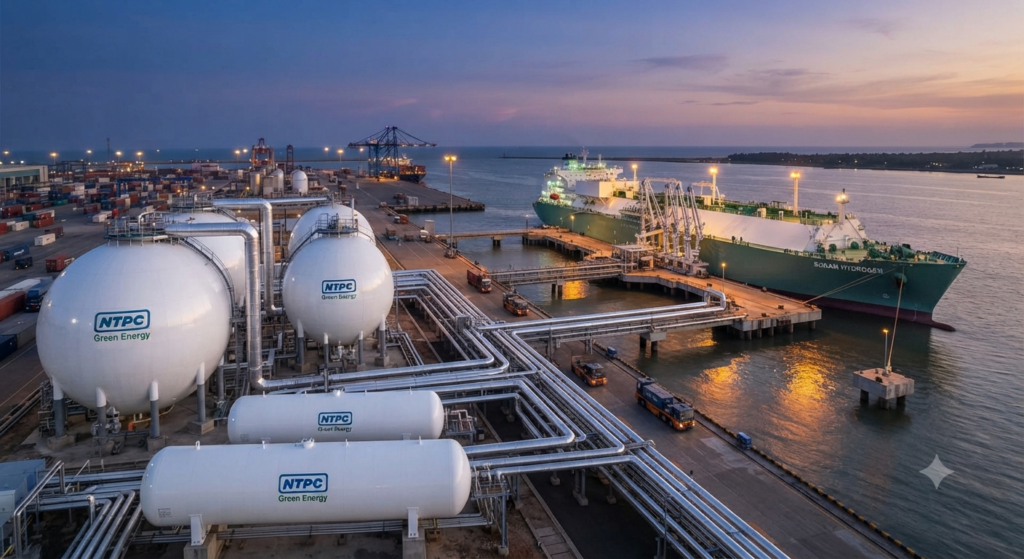
Hydrogen is the smallest molecule and is highly volatile. Storing it and transporting it (either as a compressed gas or a cryogenic liquid) is complex and energy-intensive. Shipping it as Green Ammonia is easier, but conversion adds cost.
Building the pipelines, storage terminals, and specialized port infrastructure is a multi-trillion-rupee challenge that requires unprecedented collaboration between the public sector and private industry.
A New Era of Indian Leadership
The global Green Hydrogen race is not a sprint; it is a marathon that will be defined over the next 20 years.
The nations that win will be those that possess the foresight to invest today, the industrial capacity to scale tomorrow, and the geopolitical trust to lead the day after.
India’s National Green Hydrogen Mission is a declaration of intent. It is a statement that India is no longer a follower in the global industrial order, but a pioneer. By harnessing the power of our sunlight, the resilience of our industry, and the vision of our policymakers, India is not just cleaning its own skies.
We are fueling the future of the world. This is the true meaning of BharatUday—the modern rise of a clean energy superpower.
“कर्मण्येवाधिकारस्ते मा फलेषु कदाचन।” — Bhagavad Gita, Chapter 2, Verse 47
“You have a right to perform your prescribed duty, but you are not entitled to the fruits of action.”
As India paves the way toward a sustainable and self-reliant energy future through the National Green Hydrogen Mission, this timeless wisdom reminds us to focus steadfastly on our collective duty of action, innovation, and environmental stewardship—leaving the enduring fruits of a greener planet for generations to come.
Important Notes & References
1. Nodal Ministry & Policy Blueprint: All strategic targets, financial allocations, and governance frameworks are drawn directly from the Ministry of New and Renewable Energy (MNRE), Government of India’s National Green Hydrogen Mission policy guidelines.
2. Cabinet Approval & Financial Outlay: The overarching initiative received official Union Cabinet approval on January 4, 2023, backed by an initial financial outlay of ₹19,744 crore.
3. Production & Capacity Targets (by 2030):
- Targeted national production capacity of at least 5 Million Metric Tonnes (MMT) per annum.
- Integration of approximately 125 GW of associated renewable energy capacity.
- Mobilization of over ₹8 lakh crore in total investments and the generation of more than 600,000 jobs.
- Projected abatement of nearly 50 MMT of annual greenhouse gas emissions alongside a reduction in cumulative fossil fuel imports exceeding ₹1 lakh crore.
4. SIGHT Programme Breakdown: The Strategic Interventions for Green Hydrogen Transition (SIGHT) scheme allocates a major financial component of ₹17,490 crore specifically targeted at incentivizing domestic electrolyzer manufacturing and green hydrogen production.
5. Export & Global Hub Infrastructure: Strategic positioning aims to capture a 10% share of the global green hydrogen market, facilitating export pathways through dedicated green hydrogen hubs and maritime infrastructure across key ports such as Mundra, Paradip, and Tuticorin.