

Imagine, for a moment, that the universe is not made of matter, but of vibration—a cosmic symphony where every note is a number, and every melody is a geometric constant. Long before the West formalised the tempered scale, and millennia before modern computing dared to map the possibilities of frequency, our ancestors in Bharat were already walking this path. They did not just “compose” music; they decoded the fundamental laws of existence.
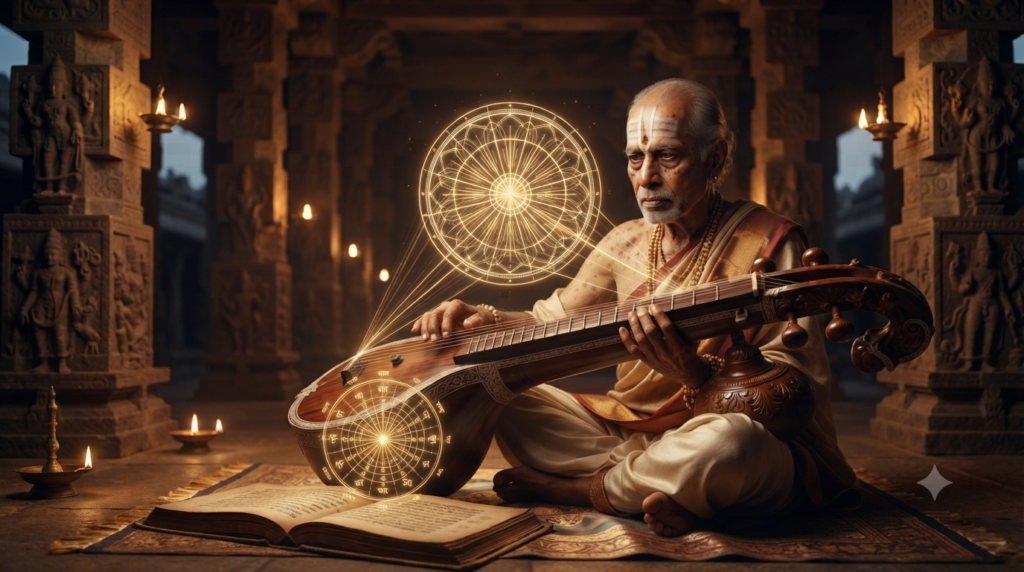
At the center of this unparalleled intellectual triumph lies the Melakarta System—a classification framework so logically perfect that it stands as perhaps the greatest mathematical achievement in the history of global musicology.
The Divine Logic of Nada Brahma
To understand the Melakarta system, one must first shed the modern notion that music is merely “art.” In the vision of Bharat, music is Nada Brahma—the Supreme Reality manifesting as sound. This was not a mystical abstraction; it was a rigorous, scientific worldview. Our ancients believed that if one could master the sound, one could mirror the order of the cosmos itself.
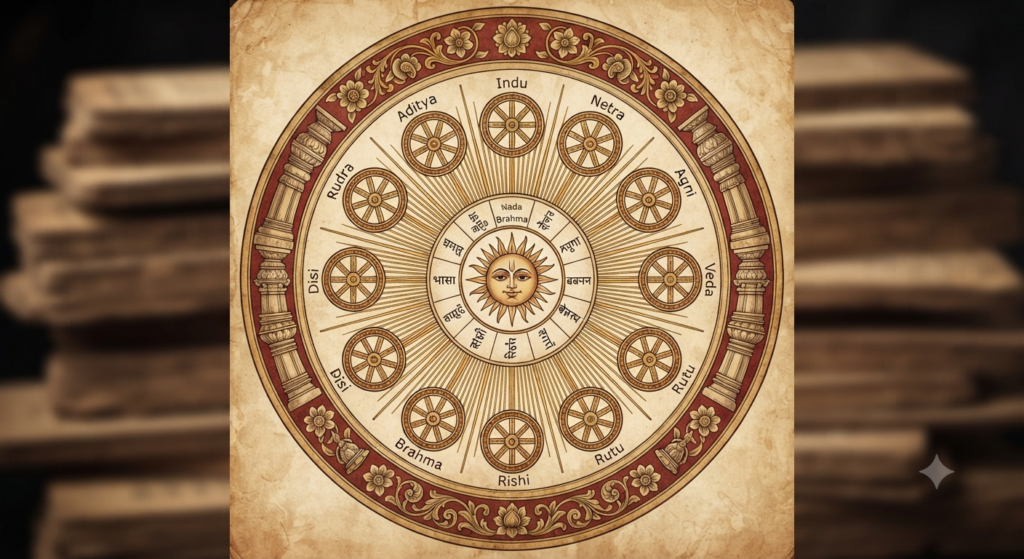
When a practitioner of the Natya Shastra looked at a musical scale, they did not see a whimsical sequence of pitches. They saw a grid of potential. They understood that the octave was not a vague range of sound, but a precise mathematical space that could be partitioned, analysed, and perfected.
The 72 Pillars of Sound: A Mathematical Marvel
In the vast ocean of Indian Classical Music, particularly within the Carnatic tradition, the Melakarta system is the realisation of this exhaustive pursuit. The Melakarta system stands as a lighthouse of logic. It is a comprehensive classification system that categorises all possible ‘parent’ raga(known as Janaka ragas) into 72 distinct, logical patterns. This is not merely an artistic choice; it is an exhaustive mathematical mapping of the octave, ensuring that no potential harmonic variation is left undocumented. Think about the audacity of that number for a moment. Through a precise system of permutations, our ancient scholars accounted for every single harmonic possibility that human ears could find pleasing.
The system relies on the division of the seven swaras (notes)—Sa, Ri, Ga, Ma, Pa, Dha, Ni—into precise mathematical segments. By utilising the 12 semi-tones (shruti) available within an octave, the system calculates every conceivable combination that remains pleasing to the human ear. Before the West had fully codified its own systems of temperament, Bharat had already solved the geometry of sound, treating music as an exact science.
“The Melakarta system is a perfect mathematical permutation, ensuring that every raga is not just a sequence of notes, but a specific frequency map of the cosmic order.”
The Grid of Creation: Understanding the Chakras
The 72 Melakarta ragas are structured into 12 ‘chakras’ (wheels), with each chakra containing 6 ragas. This grid-like thinking reflects the Vedic obsession with order and structural integrity. Each raga is determined by the specific positioning of the variable notes: Rishabha (Ri), Gandhara (Ga), Dhaivata (Dha), and Nishada (Ni). By mathematically permuting these positions, the system achieves an exhaustive list that covers every conceivable musical mood, from the deepest melancholic depths to the soaring heights of the heroic.
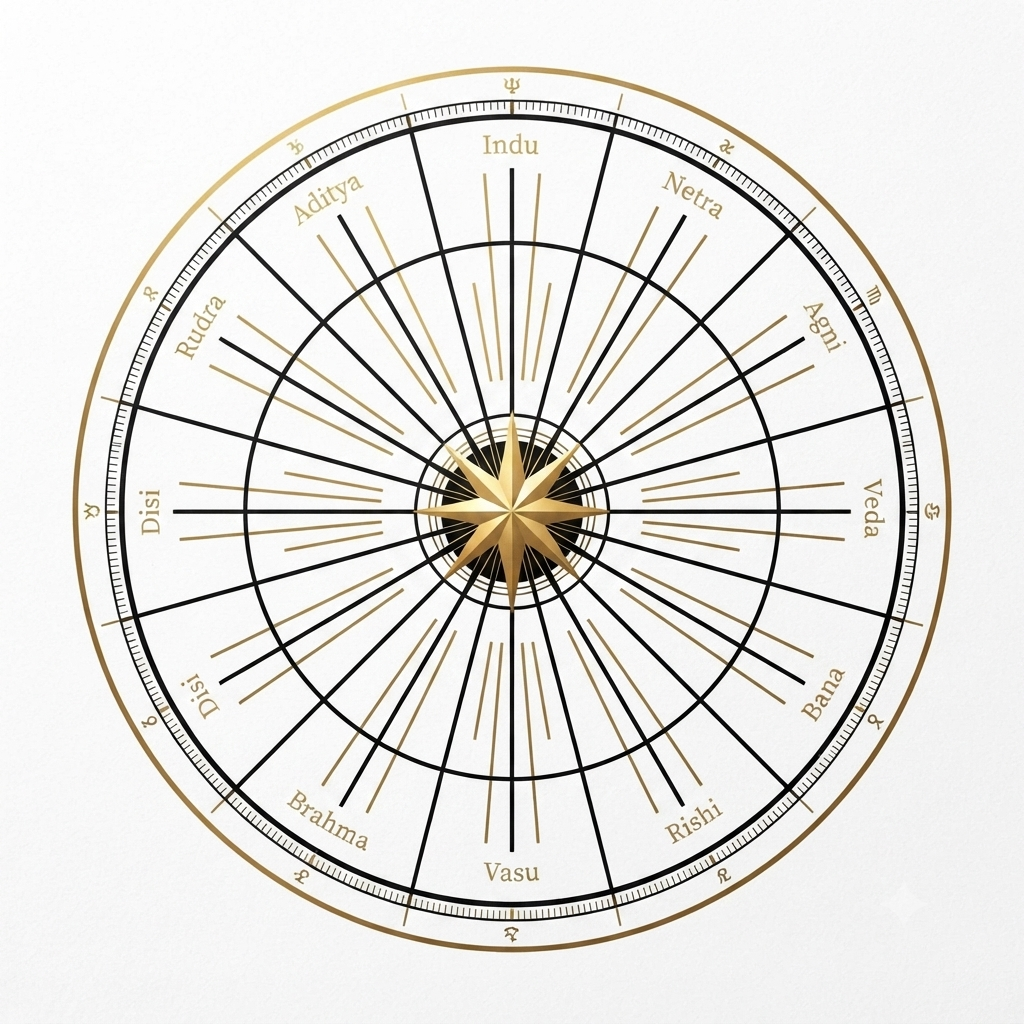
Think of this system as a musical periodic table. Just as chemistry defines the building blocks of matter, the Melakarta system defines the building blocks of human emotion. When a musician plays a raga from this system, they are not simply playing a sequence of notes; they are invoking a specific mathematical frequency that has been calibrated over centuries to resonate with the human psyche and the cosmic order. This system ensures that every possible mood—from the crushing weight of sorrow to the soaring, limitless spirit of heroism—is catalogued, identified, and ready to be invoked.
When you hear a master musician navigate these scales, you are witnessing an ancient algorithm in action—an act of intellectual discipline that turns mathematics into divinity.
The Architectural Blueprint: Chaturdandi Prakashika
The primary source for this majestic logical framework is the Chaturdandi Prakashika, penned by the visionary Venkatamakhin in the 17th century. While his work was deeply rooted in the ancient, foundational wisdom of the Natya Shastra—the seminal text attributed to the sage Bharata Muni—Venkatamakhin provided the definitive grid. His work transformed musicology into a rigorous system of classification. Venkatamakhin’s brilliance lay in his ability to categorise the infinite variety of ragas into a finite, manageable, and systematic set of 72. This system, known as the Kanakangi-Ratnangi nomenclature, is so perfect and encompassing that it remains the standard for Carnatic music today, nearly 400 years later.

Imagine the focus required to formalise a system that would remain the global standard for four centuries. He took the infinite and made it finite. He took the intangible and made it empirical. His work remains a testament to a civilisation that did not fear complexity, but rather embraced it to organise the very fabric of human experience.
The Philosophical Depth: Music as Cosmic Order
For the ancient practitioners of Bharat, music was Nada Brahma—the divine sound that permeates the universe. The quantification of raga was not an attempt to limit art, but to understand the fundamental laws that govern the cosmos. By mapping every possible sound combination, the ancient masters were essentially mapping the potential vibrations of existence itself.
A Geometry That Stirs the Soul
Why does this evoke goosebumps? Because it shatters the colonial narrative that our history was one of “superstition” or “mysticism” alone. No. Our history was one of brilliant, empirical, and uncompromising logic.

The Melakarta system proves that our ancestors looked at the chaos of sound and refused to be overwhelmed. They built a mathematical fortress around it. They treated the Veena not just as a wooden instrument, but as a scientific tool for measuring the resonance of the universe. When the strings are plucked, you are hearing the sound of geometry—the triumph of a civilisation that understood the universe is a symphony, and we hold the score.
Why This Matters Today: Reclaiming Our Intellectual Heritage
In an age where we often look exclusively to Western technological and logical frameworks, the Melakarta system stands as a stark, powerful reminder of our own intellectual heritage. Our culture did not just produce beautiful, soul- stirring music; it produced a rigorous, scientific methodology to organise it.
We are not just the descendants of poets; we are the descendants of architects of the mind. Every time we study these ancient systems, we are not just “learning music”—we are reclaiming our right to define the structures of human knowledge. We are reconnecting with a legacy that did not just feel the beauty of the world—it calculated it.
As you walk through your day, remember the Veena. Remember the 72 Ragas. Remember that you come from a lineage that stood at the edge of the infinite and decided to give it a name and a number. This is the pride of BharatVirasat—the knowledge that our roots are not buried in the dark, but in the light of profound, analytical brilliance.
“The universe is composed of sound, and Bharat taught us how to calculate it.”
As we reflect on this mastery of cosmic order and the disciplined application of knowledge, we are reminded of the profound words of Lord Krishna, who speaks to the necessity of finding the divine through the path of understanding and structured action.
“yuktāhāra-vihārasya yukta-cheṣṭasya karmasu | yukta-svapnāvabodhasya yogo bhavati duḥkha-hā ||”(Bhagavad Gita 6.17)
“He who is regulated in his habits of eating, sleeping, recreation, and work can mitigate all material pains by practising the yoga system.”
Just as our ancient masters achieved the “Yoga of Sound” through the regulated, disciplined structure of the Melakarta system, so too do we find our strength by regulating our lives and reconnecting with the deep, structured wisdom of our ancestors.
Historical References and Notes:
- Natya Shastra: Attributed to sage Bharata Muni (c. 200 BCE – 200 CE), this
encyclopedic text serves as the foundation for all Indian performing arts, emphasising
the structural and emotional impact of sound. - Chaturdandi Prakashika: Written by Venkatamakhin (17th Century), this landmark
treatise codified the 72 Melakarta system, providing the standard for Raga classification
that persists in contemporary Carnatic music. - Nada Brahma: A central philosophical concept in Indian musicology, suggesting that
the entire universe is a manifestation of sound vibration.