

For decades, modern aerial warfare was defined by missile range and radar stealth. But as low-cost kamikaze drones, swarm attacks, and saturation strikes began to dominate 21st-century battlefields, a critical vulnerability emerged in global defence architecture: human reaction time and fragmented sensor networks.
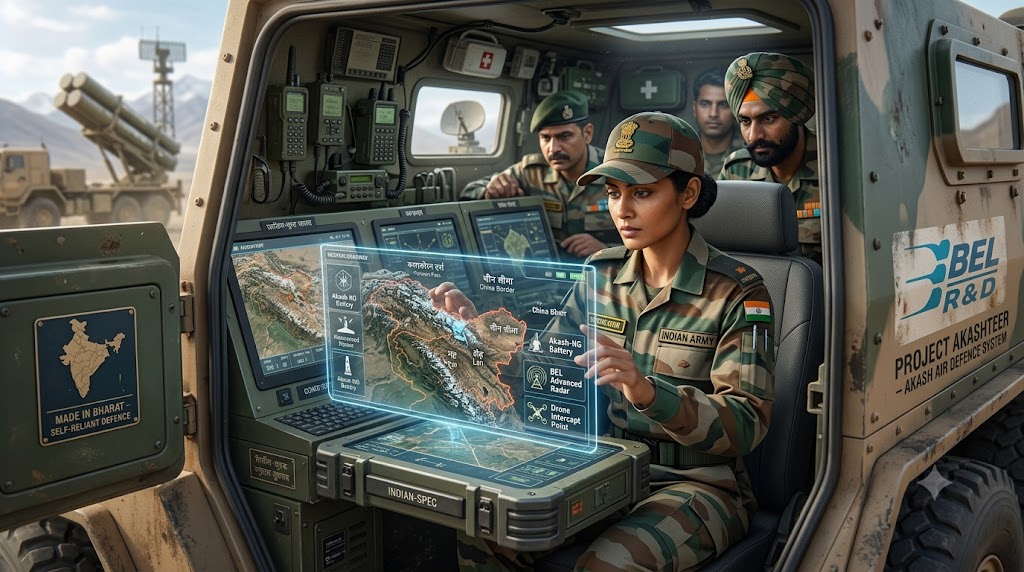
Enter Akashteer (Air Defence Control and Reporting System)—Bharat’s indigenous, fully automated Command, Control, Communications, Computers, Intelligence, Surveillance, and Reconnaissance (C4ISR) system. Developed by Bharat Electronics Limited (BEL) under the Atmanirbhar Bharat vision, Akashteer is not a missile launcher or a radar unit. It is the digital brain that unites every air defence asset into a single, automated, unhackable operational mesh.
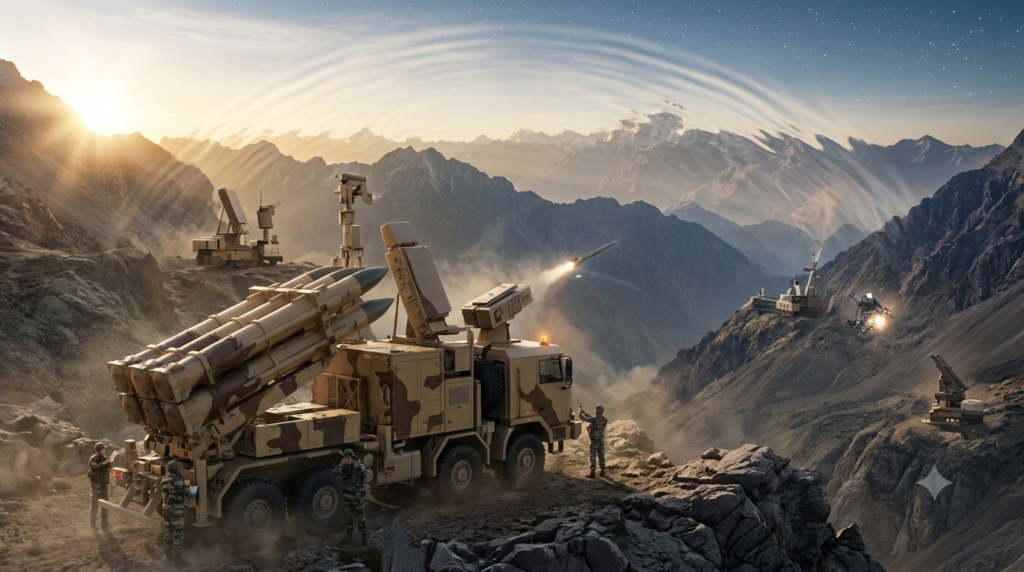
During Operation Sindoor, Akashteer faced its ultimate baptism by fire, achieving a historic 100% interception rate against massive enemy drone swarms and establishing Bharat as a global leader in next-generation battle management.
1. The Genesis: Indigenous Engineering by BEL
Traditionally, air defence forces relied on isolated radar stations relaying data via voice communications or fragmented data links to local command posts. In high-density saturation attacks—where hundreds of low-flying drones, loitering munitions, and incoming missiles flood the sky within seconds—human operators face severe cognitive overload.
Recognizing this operational gap, the Ministry of Defence partnered with Bharat Electronics Limited (BEL) to conceptualize Project Akashteer. Designed and manufactured entirely in Bharat, BEL engineered a vehicle-mounted, highly mobile air defence network capable of operating in rugged border terrains, high-altitude desert sectors, and forward battle zones.
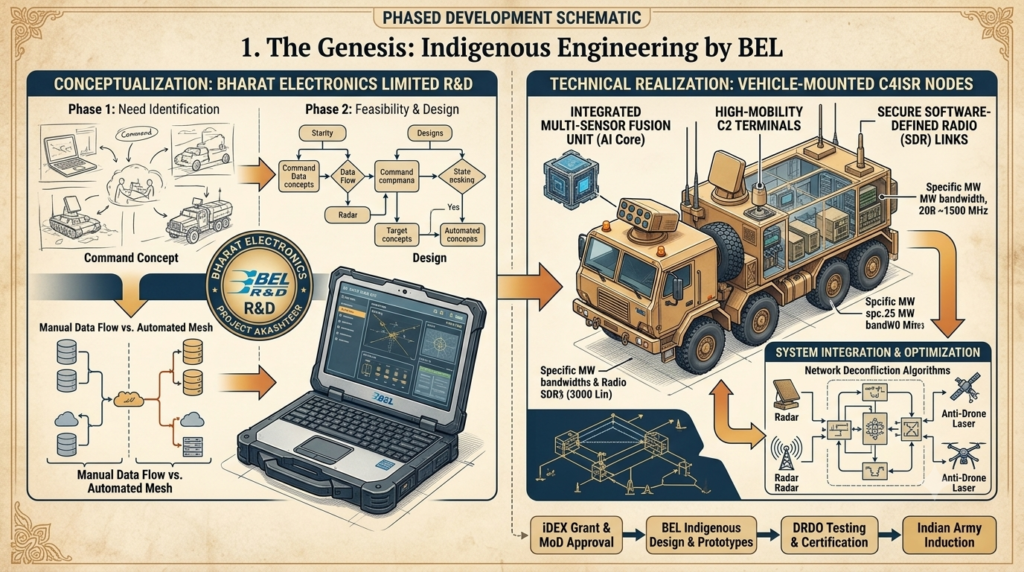
Unlike static command centers vulnerable to missile strikes, Akashteer operates from off-road 4×4 and 6×6 tactical vehicles, allowing command units to move continuously while maintaining real-time connectivity across hundreds of kilometers.
2. Under the Hood: What Makes Akashteer Unique in the World?
Akashteer is one of the world’s first fully integrated, AI-assisted tactical air defence control systems capable of handling low-altitude airspaces seamlessly. While legacy systems focus primarily on high-altitude jet threats, Akashteer unifies the entire spectrum of low, medium, and high-altitude threats.
Key Technical Architecture:
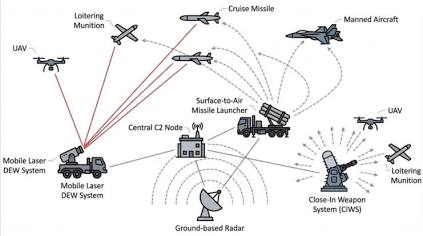
- Multi-Sensor Data Fusion (MSDF): Akashteer aggregates live feeds from early warning radars, low-level lightweight radars (LLWR), electro-optical sensors, visual observation posts, and tactical drone detectors. It eliminates duplicate targets and builds a single, unified Air Situation Picture (ASP) in real time.
- Automated Threat Evaluation & Weapon Assignment (TEWA): Rather than waiting for a commander to analyze radar blips, Akashteer’s AI engine ranks incoming threats based on speed, trajectory, and proximity to critical assets. Within milliseconds, it automatically recommends or assigns the optimal weapon system—whether an L-70 air defence gun, an Akash surface-to-air missile battery, or a directed-energy anti-drone laser—to neutralize the threat.
- Deconfliction & De-risking (Prevention of Friendly Fire): By integrating friend-or-foe identification (IFF) and linking with the Indian Air Force’s IACCS (Integrated Air Command and Control System) and the Indian Navy’s TRIGUN network, Akashteer ensures friendly aircraft, helicopters, and drones pass safely while lethal fire is directed only at hostile threats.
- Network-Centric Mobility: Built to resist heavy electronic warfare (EW) and cyber-jamming, the system utilizes secure, encrypted software-defined radios (SDR) and satellite links to maintain communication even in contested electromagnetic environments.
3. The Proving Ground: Operation Sindoor
The true power of Akashteer was demonstrated during Operation Sindoor. Following intense cross-border engagements, adversary forces launched coordinated drone swarm strikes and kamikaze attacks aimed at penetrating forward positions and airbases.
As dozens of Turkish-origin kamikaze drones and indigenous low-RCS UAVs flooded the border skies simultaneously, Akashteer acted as an invisible digital dome.
“It didn’t make noise or flash; instead, it listened, calculated, and hit targets with sharp accuracy. Every threat was detected. Every target was destroyed.” — Supervising Major, Indian Army Air Defence (Forward Location)
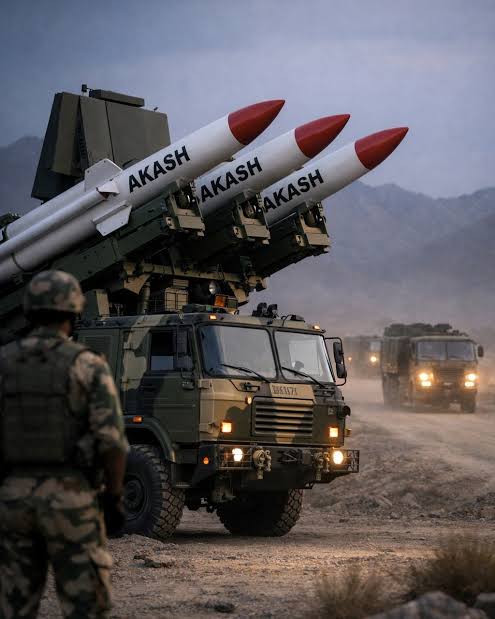
Akashteer seamlessly mapped the incoming swarm, prioritized targets by threat level, and fed firing solutions directly to forward air defence gun units and missile batteries. Not a single enemy drone penetrated the defensive grid or reached its intended target, achieving a legendary 100% kill rate on the ground.
Foreign military analysts noted that Akashteer performed better against low-cost saturation swarm tactics than traditional static air defence systems, proving the necessity of automated C4ISR networks in modern warfare.
4. Global Waves: Rising Export Demand
Following its flawless combat record in Operation Sindoor, global interest in Bharat’s air defence architecture expanded rapidly. Nations across Eurasia, Southeast Asia, and the Middle East seeking to secure their skies against low-cost drone threats turned to India.
- Central Asian Expansion: Building on previous orders for the Akash surface-to-air missile system, nations such as Armenia, Tajikistan, and Turkmenistan have engaged with Bharat for integrated air defence packages featuring Akashteer’s command nodes.
- Southeast Asian Partnership: Countries like Vietnam and Indonesia, currently modernizing their tactical air defence grids to resist regional aerial overreach, are evaluating Akashteer alongside indigenous missile systems.
- Cost-to-Capability Edge: International defense observers highlight that BEL’s Akashteer offers capabilities comparable to or exceeding Western C4ISR networks at a fraction of the cost, making it the most competitive battle management network in the global export market.

Following its proven operational track record, defence analysts and trade projections estimate the overall export market potential for Akashteer (alongside integrated Akash surface-to-air missile packages) to reach $1.5 billion to $2 billion over the next 3–5 years.Bharat Electronics Limited (BEL) aims to increase its overall export revenue share to 10–15% of total annual turnover, with Akashteer positioned as one of its flagship digital C4ISR exports alongside coastal surveillance and radar networks.
5. What’s Next for Akashteer?
The success of Akashteer in Operation Sindoor marks just the first step in Bharat’s air defence evolution. Under Mission Sudarshan Chakra, Indian defence forces are actively linking Army, Air Force, and Navy networks into a tri-service operational shield.
Future iterations of Akashteer are integrating:
- Direct Anti-Drone Laser Integration: Instant automated control of high-power laser weapons to fry drone swarms at optical speeds.
- Predictive AI Trajectory Modeling: Machine learning algorithms designed to predict hypersonic missile paths and adjust interception vectors in microseconds.
- Space-Based Early Warning Links: Direct feeds from defense satellite constellations to track threats from launch to terminal phase.
Conclusion
Project Akashteer represents a monumental shift in Bharat’s military philosophy. It proves that modern warfare is no longer won solely by firepower, but by the intelligence, speed, and automation of the network connecting those weapons.
Designed in Bharat, built by BEL, and battle-tested in Operation Sindoor, Akashteer stands as a testament to Atmanirbhar Bharat—shielding our nation’s skies while establishing Bharat as an undisputed power in modern defence technology.
“हतो वा प्राप्स्यसि स्वर्गं जित्वा वा भोक्ष्यसे महीम्। तस्मादुत्तिष्ठ कौन्तेय युद्धाय कृतनिश्चयः॥” (Chapter 2, Verse 37)
“If you are slain, you will attain heaven; if you conquer, you will enjoy the earth. Therefore, arise, O son of Kunti, resolved to stand firm and fulfill your duty.”
References
- Ministry of Defence, Government of India
- “Aatmanirbhar Bharat: MoD inks contract worth ₹2,400 crore with Bharat Electronics Limited (BEL) for Project Akashteer (Automated Air Defence Control & Reporting System).” Press Information Bureau (PIB), New Delhi.
- Bharat Electronics Limited (BEL)
- “Automated Air Defence Control & Reporting System (ADC&RS) — Akashteer Product Architecture & Technical Specifications.” Official Corporate Defence Communications.
- Strategic & Defense Analysis Reports
- “Akashteer: Transforming India’s Air Defence Posture with Cutting-Edge C4ISR Integration.” The Economic Times Defense & Security Briefing.
- “Operation Sindoor: How Integrated Air Defence & AI Network Centric Warfare Secured Frontier Airspace.” Defense & Aerospace Review.
- Defence Acquisition Council (DAC)
- “Clearance for Tracked Air Defence Command & Control Systems and Tri-Services Jointness Integration (IACCS & Trigun Compatibility).” Press Information Bureau, Government of India.
- Global Defense Trade & Markets
- “India’s Growing Military Exports: C4ISR Systems and Air Defence Capabilities in High Global Demand.” Defense News & Industry Analysis.